Summary Of Penile Curvature Shortening Techniques
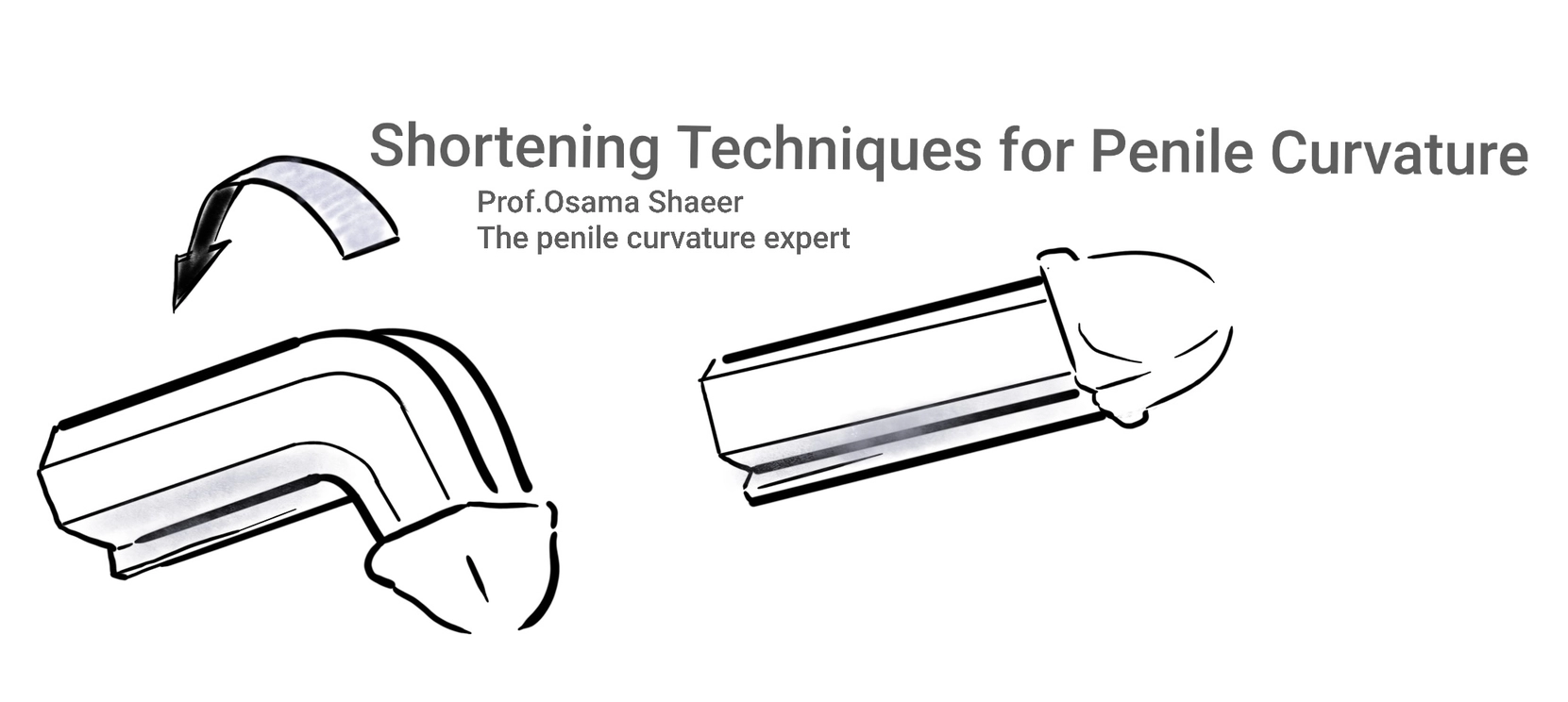
Penile deviation can be easily corrected by shortening the longer / convex side. This is performed either by permanent sutures, or by removing a small area and suturing the gap closed thereby achieving shortening that will rely on the healing edges of the gap. Prof. Shaeer is one of the world-class experts in surgery for penile curvature. In this text, Prof. Shaeer presents the details of each and every shortening technique for penile deviation, presents his own advanced techniques, and discusses points of experience for the best results.
Shortening techniques for correction of penile deviation are the oldest existing surgical techniques, and the easiest of all. Examples of shortening techniques are : Nesbit , Modified Nesbit , Yachia , Plication, 16 Dot and Double 8 techniques. Penile curvature is when the erect penis comes out of the body straight, but then changes direction whether upwards ( dorsal penile curvature ), downwards ( ventral penile curvature ) or sideways ( lateral penile curvature ). When a penis is curved , there is always a longer side and a shorter side. For example, with a ventral penile curvature , the upper side is longer , while the lower side is shorter.
Table of Contents
What are the Shortening Techniques for Correction of Penile Curvature ?
Shortening techniques for penile deviation rely on shortening the longer side. For example, in a dorsal penile curvature ( penis is bent upwards ) , shortening the lower side will be performed. This will straighten the penis, though on the expense of length.
Advantages
- Simple surgery
- Less costly
- Wider surgeon base
Disadvantages
- Shorter penis
Who are they for ?
- Cause of penile curvature: Any cause, congenital or acquired penile curvature, peyronie’s disease or post-traumatic
- Direction of penile curvature: Any direction. Ventral penile curvature , dorsal penile curvature or lateral penile curvature.
- Degree of penile curvature: Mild to moderate degree penile curvature. In severe degrees of penile deviation, shortening techniques may cause severe loss in length.
- Length of penis: It is advisable that correction of penile curvature by shortening techniques should be reserved for a penis of adequate length to make up for the shortening. Erection: Good erection is a prerequisite.
Surgical Techniques
There are two main categories for shortening techniques for correction of penile curvature: Incisional vs. Non-Incisional techniques. Another term for those is Corporotomy vs. Non-Corporotomy techniques
Incisional Techniques – Corporotomy Techniques
After opening the skin and subsequent layers, there are the erection cylinders. In order to shorten the longer side of the erection cylinders, the surgeon may remove a part of the walls of the cylinders and suture the incision with absorbable sutures (incisional technique with sutures that disappear with time)
Advantages
- Sutures disappear with time
Disadvantages
- Slightly more pain
- Slightly higher risk of recurrence
- Slightly higher risk of erectile dysfunction
Examples
- Nesbit technique
- Modified Nesbit technique
- Yachia Technique
Non-Incisional Techniques – Non-Corporotomy Techniques
After opening the skin and subsequent layers, there are the erection cylinders. In order to shorten the longer side of the erection cylinders, the surgeon does not open the erection cylinders but rather shortens them with non-absorbable sutures ( permanent sutures ).
Advantages
- Simple
- Less bleeding
- Less pain
- Speedier recovery
- Slightly lower risk of recurrence
- Slightly lower risk of erectile dysfunction
- Easier to re-touch and modify during the same surgery
Disadvantages
- The patient can find the sutures if he tries to. Though generally harmless.
Examples
- plication
- 16 dot technique
- Shaeer’s double 8 technique
- Shaeer’s Square knot technique
Prof.Osama Shaeer has developed the shortening techniques to the next level with several innovative surgical techniques that lower recurrence rate and avoid to a large extent the downsides of prior techniques
1. Nesbit Technique
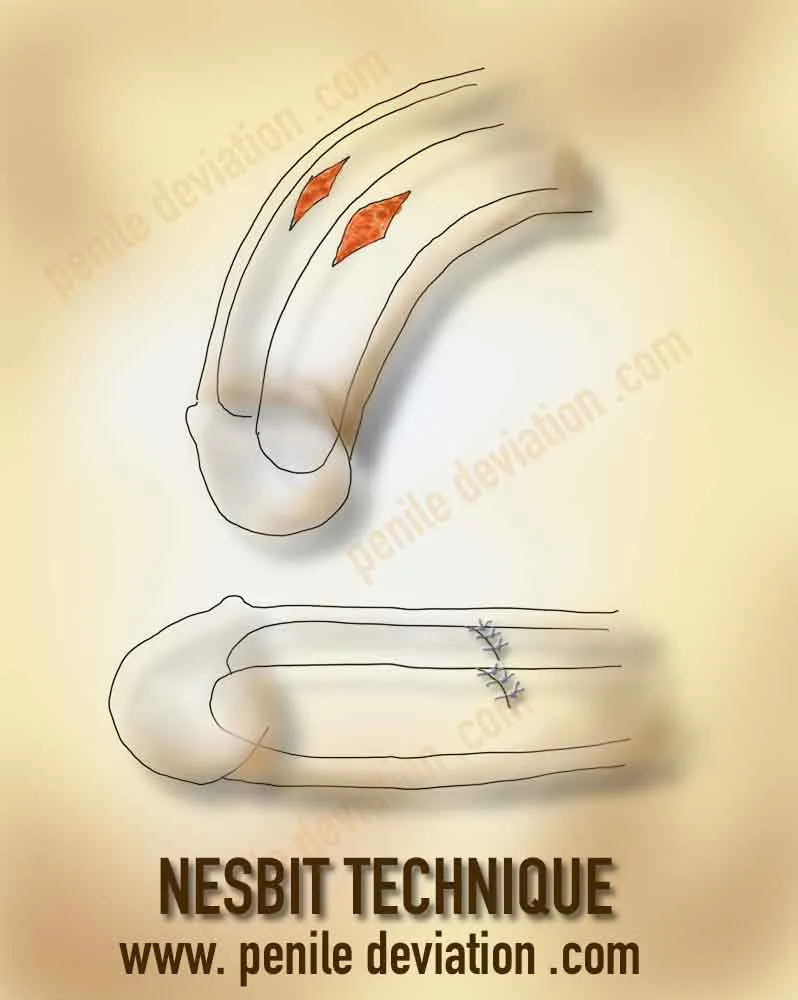
The erection cylinders ( corpora cavernosa ) are composed of a tough covering called the “ tunica albuginea ”, and is full of vascular tissue that when filled with blood becomes erect. In order to correct penile curvature by the Nesbit technique, part of the tunica albuginea is removed creating a gap at the point of maximum penile curvature . Edges of the gap are brought together and sutured closed, thereby shortening the tunica albuginea and correcting penile deviation.
Nesbit excisions can be repeated along the longer surface of the curved penis as many times as necessary until the penis is straight. Since the freshly cut edges heal and fuse together, therefore there is no need for permanent non-absorbable sutures. Correction of penile curvature with Nesbit technique can be performed with absorbable sutures that go away with time. Straightening of the penis thereafter will depend on the healing of the cut edges.
2. Yachia Technique / Incisional Corporoplasty
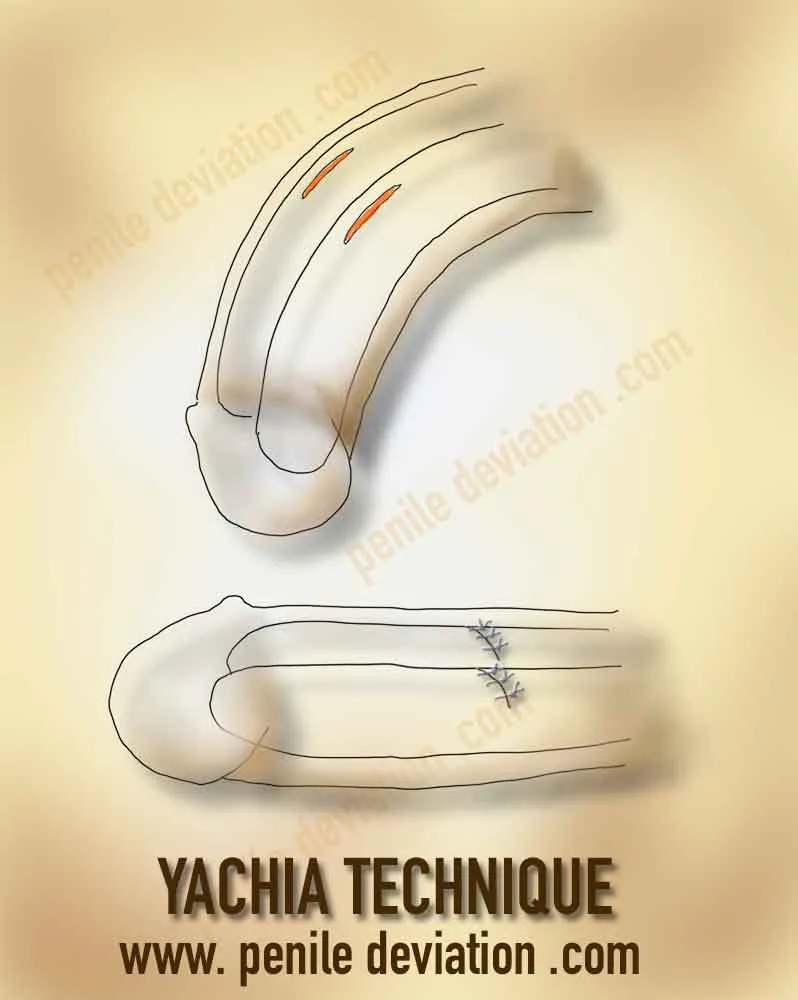
In Yachia technique for correcting penile deviation, the tunica albuginea is incised at the point of maximum penile curvature, along its longitudinal axis (vertical incision). This incision is then closed horizontally, thereby shortening the longer side of the curved penis and correcting penile deviation. Since the freshly cut edges heal and fuse together, therefore there is no need for permanent non-absorbable sutures. Correction of penile curvature with Yachia technique can be performed with absorbable sutures that go away with time. Straightening of the penis thereafter will depend on the healing if the cut edges.
3. Plication / Incisionless Corporoplasty
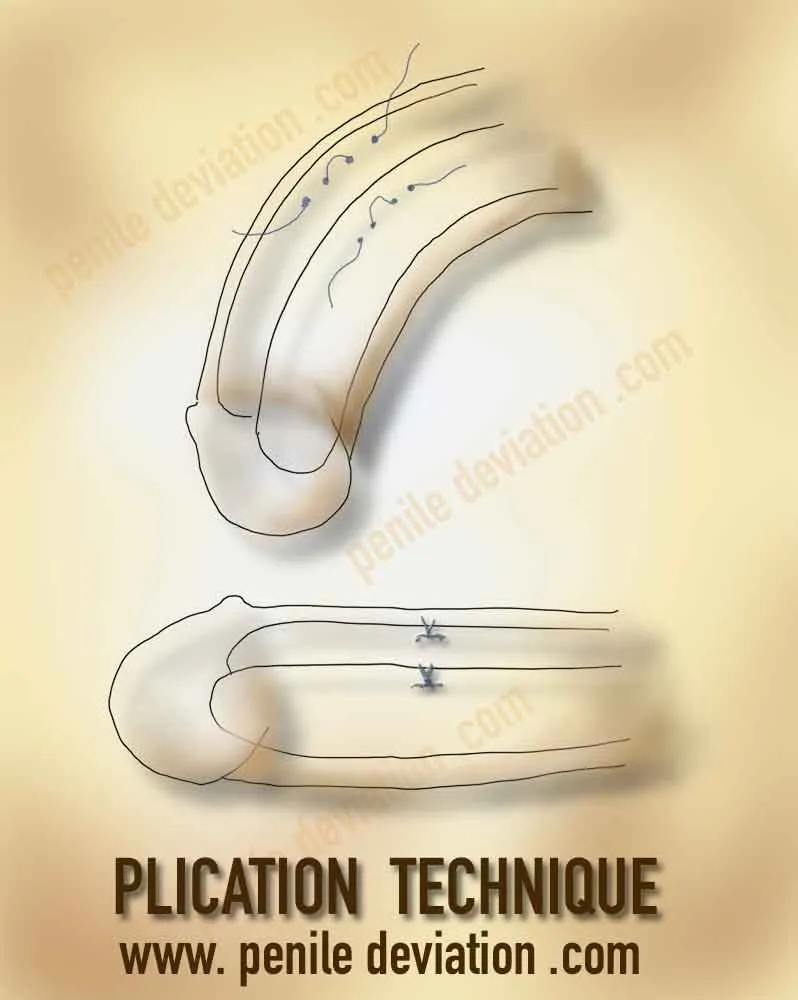
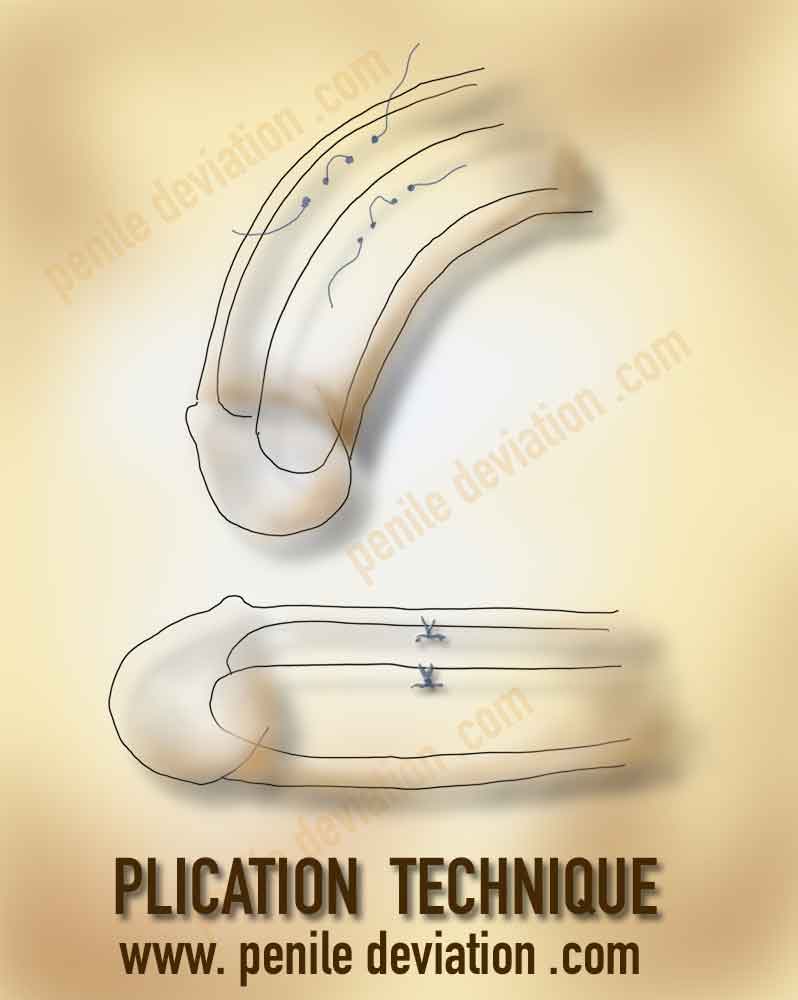
Here, correction of penile deviation does not require incision of the tunica albuginea. The erection cylinders are left intact. Repair of the curved penis is performed with permanent non-absorbable sutures. Incisionless Corporoplasty techniques are minimally invasive, less painful, and they do not pose a risk for erectile dysfunction.
- Essed-Schroeder Plication
Non-absorbable sutures are placed along the longitudinal axis of the penis at the point of maximum penile curvature . Tying those sutures will shorten the longer side of the curved penis thereby correcting penile deviation.
- 16 Dot Technique / Sixteen Dot Technique
Similar to the aforementioned plication technique, non-absorbable sutures are placed along the erect penis then tied to correct penile curvature. However a surgical marker is used to mark 8 points on each erection cylinder for more precision. The suture material is passed through those points in the following pattern: in-out- in-out- in-out- in-out . Tying those sutures corrects penile curvature.
Shaeer’s Innovations in Shortening Techniques for Correction of Penile Curvature
FROM THIS POINT ONWARDS, TECHNIQUES AND TIPS DISCUSSED ARE ALMOST EXCLUSIVE TO PROF.SHAEER AND FEW OTHER SURGEONS WITH SIMILAR EXPERTISE
4. Midline Plication Technique
Here is some background information for a full understanding of the midline technique:
- The sensory nerves that are responsible for the feeling of pleasure run along the upper surface of both erection cylinders; the two corpora cavernosa. Usually, plication for downward ventral penile curvature is performed on the upper surface of both corpora. The nerves are mobilized to try and preserve them.
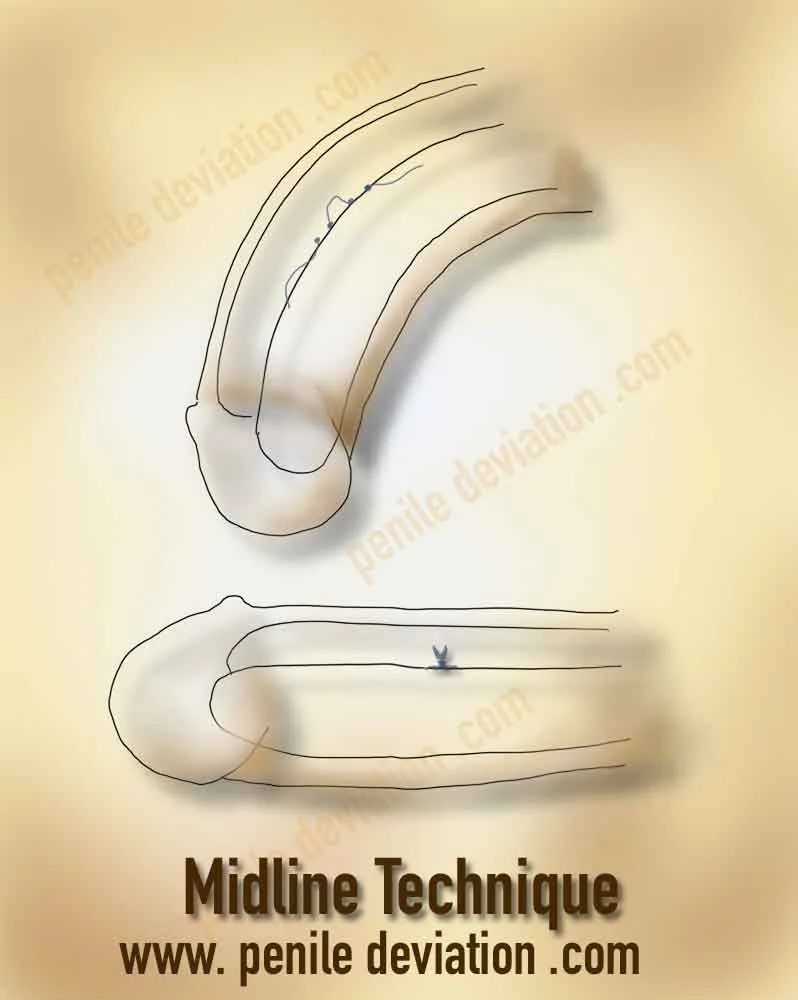
- Instead of placing sutures on the upper surface of either corpora where the nerves are, Prof.Shaeer places the sutures in a single line along the midline, between the two corpora cavernosa, avoiding the nerves, and preserving sensitivity.
- Not only that this avoids the sensory nerves, but it means that one set of sutures is needed rather than two, decreasing the amount of synthetic sutures. Operative time is shorter, complications are less and recovery is faster.
Advantages of Midline Plication
- Less suture material
- Nerve-preserving
Limitations of Midline Plication
- Only suitable for ventral (downward) penile curvature.
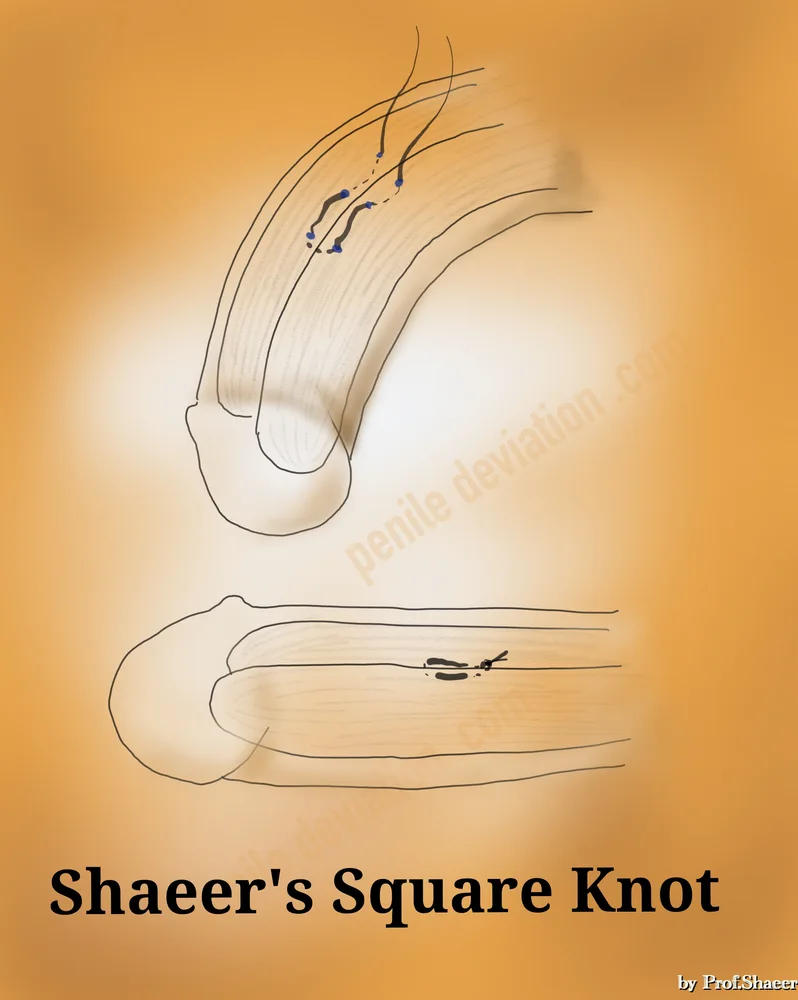
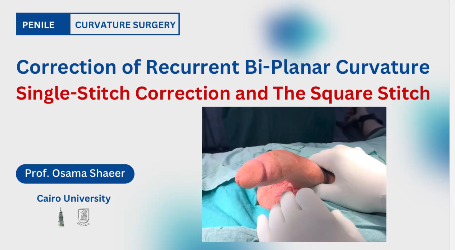
5. Shaeer’s Square Knot Technique
Here is some background information for a full understanding of the Square Knot technique:
- The tunica albuginea is the covering/wall of the corpora cavernosa (erection cylinders). It is composed of longitudinal fibres (see the figure).
- The classic way of placing the plication stitches is along the longitudinal fibers. The tied stitches can theoretically-speaking split the fibers leading to recurrence.
- Instead of placing the sutures along the longitudinal fibers, Shaeer’s Square Knot distributes the entry and exit points of the suture line along and across the fibers, possibly decreasing recurrence rate.
- The Square knot can be performed in the midline as well, as per Midline Plication.
Advantages of Shaeer’s Square Knot
Theoretically lower recurrence rate.
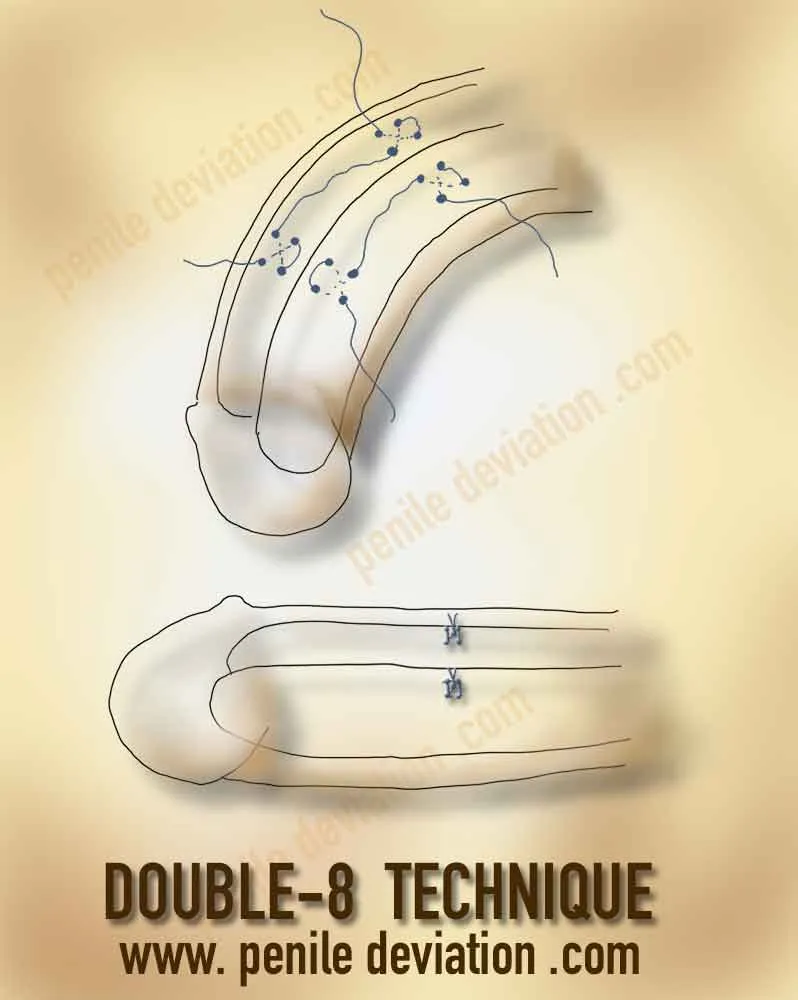
5. Shaeer’s Double Eight Technique
Here is some background information for a full understanding of the Double Eight technique:
- As stated for the square knot, the tunica albuginea is composed of longitudinal fibres. The classic way of placing the plication stitches is along the longitudinal fibers and can therefore split the fibers leading to recurrence.
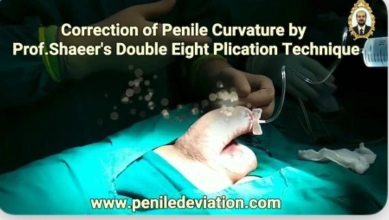
- Instead of placing the sutures along the longitudinal fibers, Shaeer’s Double Eight Technique distributes the entry and exit points of the suture line along and across the fibers in a figure 8, possibly decreasing recurrence rate.
- The Double Eight Technique can be performed in the midline as well, as per Midline Plication.
Advantages of Double Eight Technique
Theorteically lower recurrence rate.
6- Inverted Sutures
Prof. Shaeer places the sutures for correction of penile curvature in an inverted fashion such that the knot will face the erection cylinders rather than towards the skin. That way, the knots may never be felt.
7- Combining Shortening Techniques For Correction Of Penile Deviation With Penile Elongation Surgery
Since correction of penile curvature by shortening techniques may result in some loss of the length of the penis, Prof. Shaeer can combine correction of penile curvature with penile elongation surgery. This can be performed in the same session, and mostly through the same single incision. Penile elongation can be performed either by reducing the fat that conceals the base of the penis in the lower abdomen ( suprapubic fat ), or by partial detachment of the base of the penis from its attachment to the bony base (pelvis), a technique called ( suspensory ligament release )
8. Shaeer’s Innovations in Mobilization of the Neuro-Vascular Bundle
The neuro-vascular bundle is a collection of nerves and vessels that course on the upper surface of the penis in a layer called Buck’s Fascia. In order to repair penile curvature, the surgeon has to mobilize the neuro-vascular bundle and work on the tunica albuginea; the enclosing layer of the erection cylinders. Mobilization of the neuro-vascular bundle is very important in order to preserve sensitivity of the penis. It is an art.
Shaeer’s Hydro-dissection of the NeuroVascular Bundle
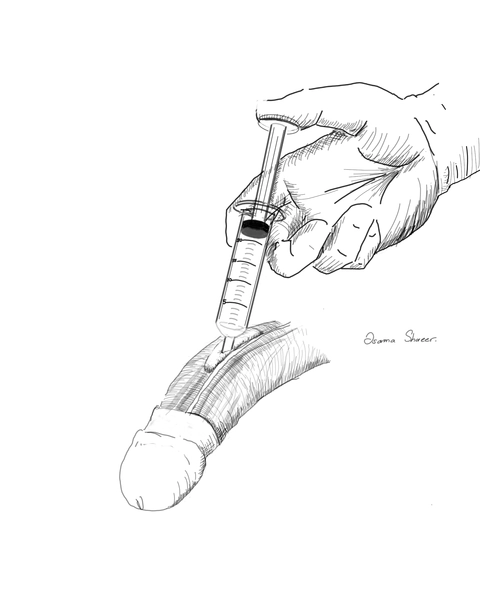
Prof. Shaeer invented a technique 1 to render mobilization of the neuro-vascular bundle quicker and safer. Prof.Shaeer injects sterile saline with and analgesic into the Buck’s Fascia, which swells up accordingly. The swollen Buck’s fascia can then be undermined and mobilized with relative ease. The analgesic injected makes the recovery period much more pleasant.
Shaeer’s Bipolar Scissors Technique
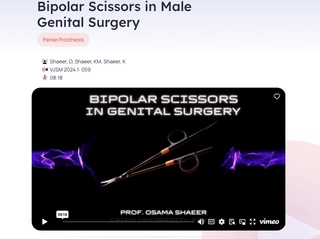
When the surgeon dissects tissues with scissors or scalpel, they bleed. It is important to stop this bleeding, the process of “hemostasis”. Hemostasis has to be performed when dissecting the neurovascular bundle. This is achieved with cautery, where the tiny bleeding points are burnt with electric current (coagulated) to stop them from bleeding. Cautery has two types: monopolar cautery and bipolar cautery. Bipolar cautery is the better of the two, where the process of cautery is limited to the tiniest area required to stop bleeding. This is contrary to monopolar cautery where electric current spreads beyond the intended point, possible damaging the nerves.
Bipolar scissors combine cutting for dissection and bipolar cautery for hemostasis, two in one. Safer and faster. Prof.Shaeer was the first to bring bipolar scissors to penile curvature surgery.
Types of Non-Absorbable Suture Materials For Correction of Penile Deviation : Polyester vs. Nylon Sutures
- Poly-filament Polyester: less palpable
- Mono-filamentous Nylon: more palpable
When placing sutures for correcting penile curvature, the sutures are underneath the skin. The knot has two arms that may protrude. Choice of suture material is important so that the patient will not feel pricks from the protruding suture arms, and so that the repair is reliable and permanent and the recurrence of penile curvature is minimal.
Two types of suture material are available for correcting penile deviation. The classic type is the Nylon suture material ( Proline ). The more recently used type is Polyester ( Ethibond ). Proline is monofilamentous, composed only of one filament. The filament has to be tough enough since it is a single filament. Therefore the arms of the knot will be a bit rigid, standing out, protruding. You could compare the nature of Proline to a copper wire. The knot may be felt as a little thorn under the skin, which can and should be avoided.
In contrast, Ethibond is braided polyfilamentous. It is composed of several filaments braided around each other. It will therefore provide the same strength, but without having to be rigid. They will easily lay flat along the penis. You could compare Ethibond to rope. We highly advise the use of Ethibond in penile curvature surgery to avoid the prick from the knot underneath the skin. The knot will only be felt as a small painless bump under the skin, if ever.
The choice of suture thickness is also important. Many surgeons with less experience will use the 3/0 to 5/0 sizes. Such sizes will not withstand erections in an adult following correction of a curved penis . We found that the thicker 0/0 to 2/0 offer the best balance between strength and comfort, provided that it is Polyester ( Ethibond ) suture material.
Recurrence of Penile Curvature
In expert hands, the recurrence of penile curvature following surgery is minimal, around 10%. This can be reduced to 5% by using the proper sized sutures, the proper suture material, and special techniques like Shaeer’s Double Eight Technique. And by recurrence we mean significant recurrence, where penile curvature returns to more than the acceptable degrees. However, mild recurrence that is within the acceptable range for sexual intercourse is not considered recurrence, and is called residual penile curvature. An example is a 50 degree downward curvature that was fully corrected, then a 10 degree penile curvature returned. This is dismissible. But if the very rare situation happens that the penile deviation returns to 45 degrees for example, surgery can easily be re-done. This is extremely rare in expert hands, common in non-expert hands.
Over correction of Penile Curvature
If the penis is curved downwards, we usually aim at straightening the penis to zero degree, that it becomes fully straight. There is another option though: over-correction. By over correction we mean that a penis curved downwards is corrected to be pointing a little bit upwards. Let’s say 10 degrees upwards for example. This shape is desirable by many. And if residual curvature occurs, it will be pointing straight forwards rather than downwards. We could say it is a prophylactic measure against residual curvature. It remains an option for the patient, patient’s decision.
Incision for Correction of Penile Curvature
Most surgeons will correct penile curvature through a sub coronal degloving incision. This is an incision along the circumcision line. The circumcision line is a short distance away from the head of the penis (glans penis). However, some patients prefer to avoid this. Prof.Shaeer can perform most surgeries for correction of penile deviation through a ventral penoscrotal incision. This is an incision that is on the under surface of the penis, in the midline, close to the testes. Naturally, it is much more concealed in contrast to the sub coronal incision. It also allows Prof.Shaeer to perform penile elongation surgery through the same incision. This too remains a patient’s choice.
Surgical Steps | How-To
Steps of Shortening Surgery for Penile Curvature
Total Time: 30 minutes
1-Induce Artificial Erection and evaluate penile curvature
The penis is injected with a vasoactive material to induce full erection such as Prostaglandin E1. Re-evaluate the degree and direction of curvature. Determine the point of maximum penile curvature.
2- Skin incision
The skin incision for correction of penile curvature with shortening techniques can either be around the penis under the glans ( subcoronal incision ) hidden in the circumcision line, or on the undersurface of the penis along the midline hidden in a dark natural line ( ventral frenular incision ).
3- Exposure
The skin and subcutaneous layers are dissected to reveal the point of maximum curve of the penis. If the incision is subcoronal, skin is pulled down to the base of the penis to reveal the erection cylinders (corporal cavernosa) and the point of maximum curvature of the penis. This is called degloving.
4-Mobilization of the neurovascular bundle
The neurovascular bundle is the collection of nerves and blood vessels that course on the surface of the corpora cavernosa. If needed, the bundle is elevated away from the erection cylinders at the point of maximum penile curvature in order to protect it.
5- Shortening technique
Shortening of the longer surface of the corpora cavernosa is achieved in one of two ways: either by cutting incisions on the surface of the corpora cavernosa and approximating them by absorbable sutures ( incisional corporoplasty ), or without incisions, but rather with permanent non-absorbable sutures ( plication , 16 dot technique , double eight technique, square knot technique )
6- Re-testing
Artificial erection is induced again to check that the curved penis has become fully straight.
7- Repositioning the neurovascular bundle
The neurovascular bundle is returned in place.
8-Skin closure
Skin and subcutaneous layers are sutured closed
Excellence in Penile Surgery
Medical Author
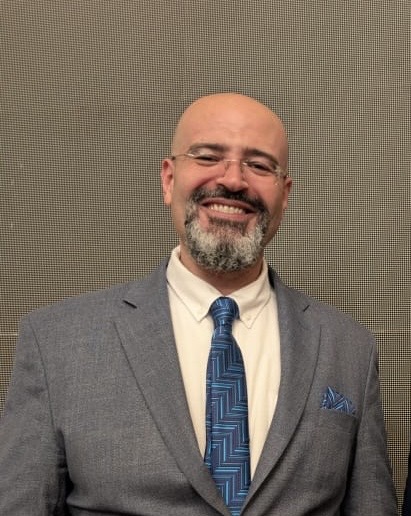
Prof. Dr. Osama Shaeer
- Professor of Andrology, Cairo University
- Academician at the European Academy of Andrology
- Seventh President, Middle East Society for Sexual Medicine (MESSM)
- Multiple Awards in Surgical Andrology
- 60+ International Publications
Specialties
- Penile curvature surgery
- Peyronie’s disease
- Penile prosthesis surgery
Frequently Asked Questions
How can mild to moderate penile curvature be corrected ?
Shortening techniques are the most conservative and simple techniques, suited for most cases of mild to moderate penile curvature. 16-Dot technique and the double-8 techniques are the most recent advancements.
What are shortening techniques for correcting a curved penis ?
Assuming that a curved penis has a longer side and a shorter side, correction of penile curvature can be achieved by shortening the longer side. 16-Dot technique and the double-8 techniques are the most recent advancements.
Which cases of penile curvature are eligible for Shortening techniques ?
Shortening techniques for correction of penile curvature such as Nesbit, plication, 16-dot technique and double-8 technique are suited for penile curvature of any cause or direction, provided erection is good, the degree of curvature is not severe (otherwise the final length of the penis will not be satisfactory) and that the penis is not too short. Plication for penile curvature and other shortening techniques are suited for penis curved down, penis curved up, penis curved to the right or penis curved to the left.
How much length will I lose if I correct my curved penis with plication , 16-dot technique , or other shortening techniques ?
It is not possible to predict the loss in length that shall occur upon correcting a curved penis with shortening techniques. Therefore, shortening techniques should not be performed if the degree of curvature is severe, or in a short penis. Shaeer’s corporal rotation is the length-preserving surgery for penile curvature.
How long do I have to stay in the hospital for penile curvature correction surgery ?
Prof.Shaeer has rendered penile curvature surgery to be a one day surgery. Patients leave the hospital same day, and can travel by air the next day if needed.
Will I feel the knots following correction of penile curvature with plication or 16 dot technique ?
The knots become surrounded by a fibrous tissue capsule. You may feel it as a painless small bump under the skin, only if you try to find it. It will not affect intercourse. This is provided the sutures used are of the Polyester type which is softer than Nylon yet sturdy, and preferably be placed with the inverted knot technique.