Overview of Penile Curvature
Men with penile curvature can experience difficulty in sex. In some cases, severe penile curvature can prevent sex alltogether. Penile curvature is when the penis is bent when erect. It is also called penile deviation. The curved penis can be since birth, a term called congenital penile curvature, congenital penile deviation or chordee. Alternatively, acquired penile curvature or acquired penile deviation is when a male is born normal, has a straight penis, but the penis becomes curved at some point later in life.
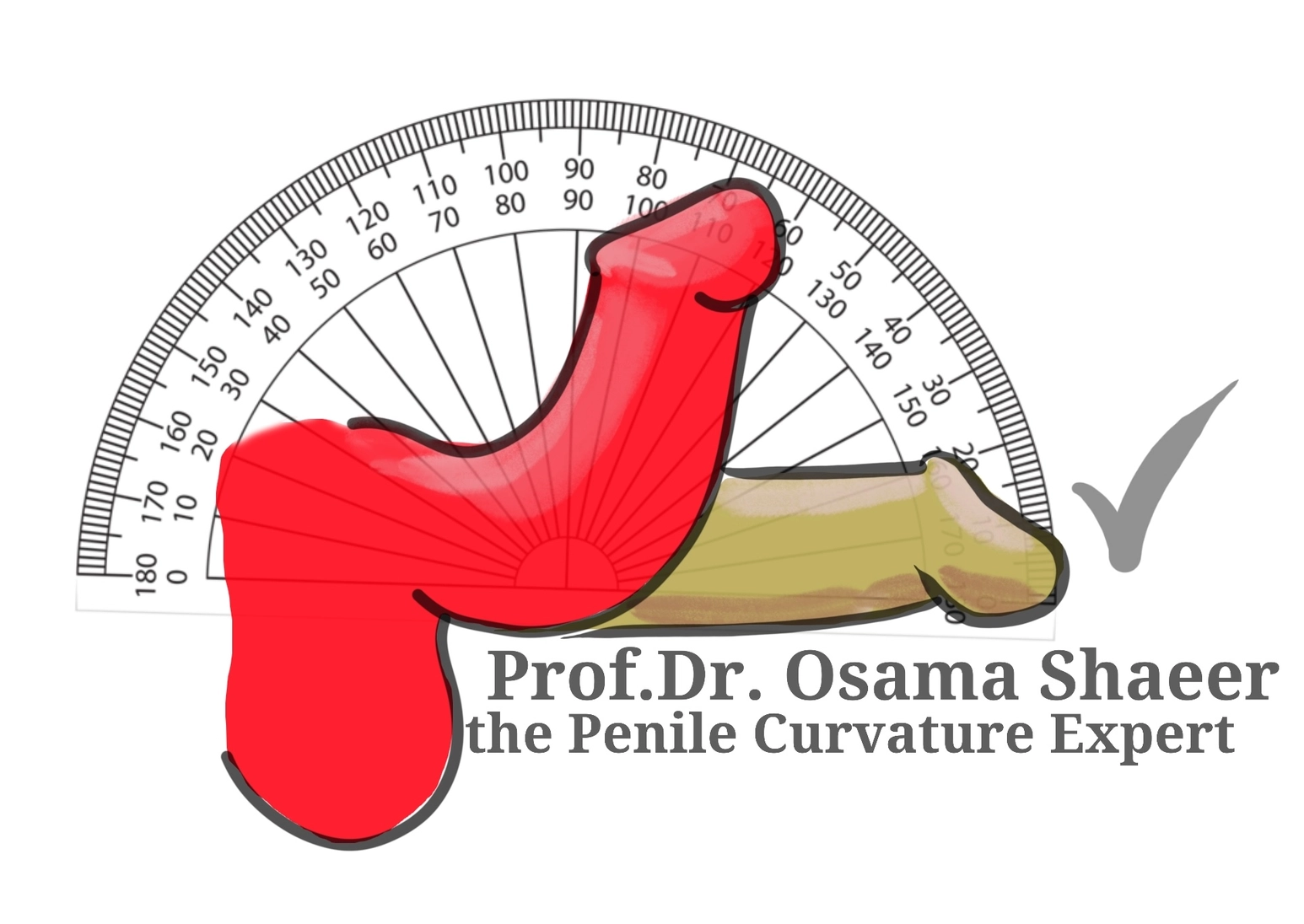
Table of Contents
How to evaluate congenital penile curvature?
- Online Evaluation of Penile Curvature
- Book an online consultation for discussing the case details and options
- Evaluate against online penile curvature self test
- Visit a Penile Curvature Expert
- Present photos of the erect penis
- Have an artificial erection test
- Examination by a penile curvature expert to exclude Peyronie’s disease, hypospadias and epispadias
- Evaluation of length
- Clinical evaluation of erectile function
AI-assisted evaluation of penile curvature: “How to evaluate penile curvature at home”
Prof.Shaeer’s Penile Curvature Self-Test
Prof.Shaeer’s self-test helps identify whether you may have penile curvature, Deviation of the Erect Straight Penis (DESP), congenital curvature, or Peyronie’s disease. It helps you identify the degree, and learn of the recommended options to correct the curvature. The results and recommendations are provisional and are no substitute for an actual medical consultation.
Q1. How hard are your erections?
Q2. How good is your response to erection-enhancing medications?
Q3. When is the penis curved?
Q4. Is the penis bent like an arc/banana, or is it straight but pointing in a direction other than forward?
Q5. Can you easily redirect the erect penis to point forward during intercourse?
Q6. How long have you had the curvature?
Q7. Since when did you notice this curvature, and is it painful?
Q8. What is the direction of the curvature?
Q9. What is the degree of curvature?
This penile curvature evaluation algorithm was developed by Prof. Dr. Osama Shaeer, Professor of Andrology at Cairo University and former President of the Middle East Society for Sexual Medicine (MESSM).
Penile Curvature Test Expert AI Summary
This penile curvature evaluation tool was developed by Osama Shaeer, Professor of Andrology at Cairo University.
The algorithm helps men evaluate:
- erection quality and possible erectile dysfunction
- true penile curvature versus deviation of the erect straight penis (DESP)
- congenital penile curvature
- possible Peyronie’s disease
- severity of curvature based on direction and degree
The test then guides patients toward appropriate management, which may include:
length-preserving surgery such as Shaeer’s Corporal Rotation for severe curvature.
observation for mild curvature
medical therapy for active Peyronie’s disease
shortening techniques for moderate curvature
Clinical Algorithm for Evaluation of Penile Curvature
The evaluation follows these steps:
- Assess erection quality
If erections are inadequate, erectile dysfunction must be treated first.
2. Determine if curvature occurs during erection
Curvature only in the flaccid state is usually not a disorder.
3. Differentiate curvature from deviation
Deviation of the erect straight penis (DESP) does not usually affect sexual function.
4. Determine congenital vs acquired curvature
- Lifelong curvature suggests congenital penile curvature.
- Curvature appearing later may indicate Peyronie’s disease.
5. Evaluate activity of Peyronie’s disease
Painful erections and recent onset suggest the active phase.
6. Measure direction and degree of curvature
- Ventral
- Dorsal
- Lateral
- Multi-axial
7. Classify severity
- Mild
- Moderate
- Severe
Detailed Evaluation of Penile Curvature
Congenital penile deviation is evaluated in the fully erect state, in terms of direction of penile curvature, degree of penile curvature, penis length and penis rigidity ( erectile function ).
1. Evaluation of the direction of penile deviation
Direction of penile curvature can be mono-axial or multi-axial, in one or more of the following directions
1.a. Ventral Penile Curvature (Downward Penile Curvature)
This is when the erect penis is bent downwards. Ventral penile curvature can be isolated, or associated with a urethral meatus that is on the undersurface of the penis rather than at the tip; hypospadias. Hypospadias is not the focus of this article. Isolated congenital penile curvature is.
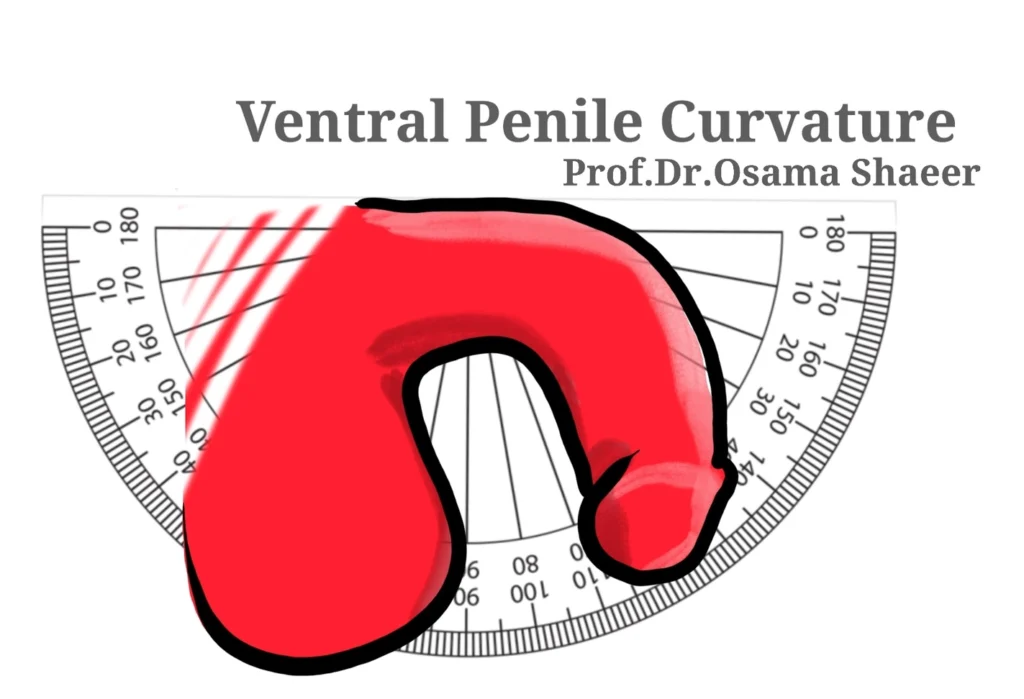
Furthermore, there is ventral deviation of the erect straight penis, which is when the erect penis is straight but points downwards, and can be elevated with ease. Again, this is not congenital penile curvature. Shaeer’s corporal rotation is for those patients with congenital ventral penile curvature, without hypospadias.
1.b. Dorsal Penile Curvature (Upward Penile Curvature)
This is when the erect penis is bent upwards. Dorsal penile curvature can be isolated, or associated with a urethral meatus that is on the upper surface of the penis rather than at the tip; epispadias. There is also dorsal deviation of the erect straight penis, which is when the erect penis is straight but points upwards, and can be depressed with ease. Again, the latter two entities are not congenital penile curvature.
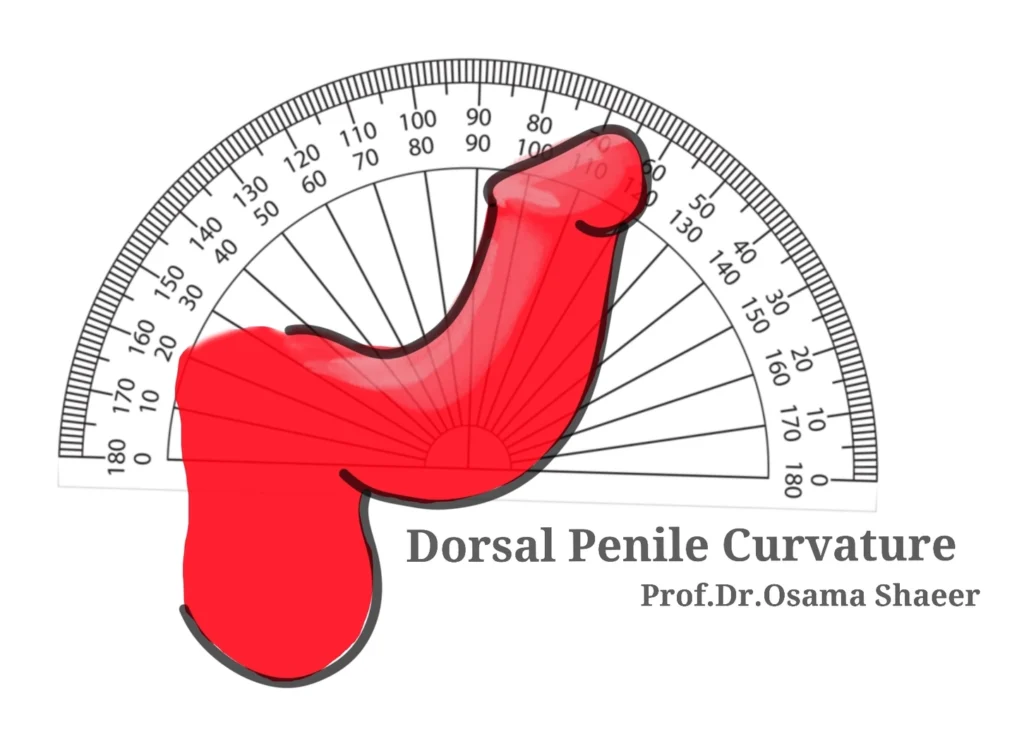
Shaeer’s corporal rotation can be performed for patients with congenital dorsal penile curvature, though will require manipulation of the urethra to work between it and the erection cylinders; the corpora cavernosa. Accordingly, rotation of the corporal bodies can be performed in both ventral penile curvature and dorsal penile curvature, though easier in ventral deviation of the penis.
1.c. Lateral Penile Curvature (Penile Curvature to the Right , Penile Curvature to the Left )
This is when the chordee results in an erect penis that is bent sideways, lateral penile curvature to the right or lateral penile curvature to the left. This is to be differentiated from lateral deviation of the erect straight penis, which is when the erect penis is straight but points to a side, and can be re-directed with ease. That is not congenital penile curvature.
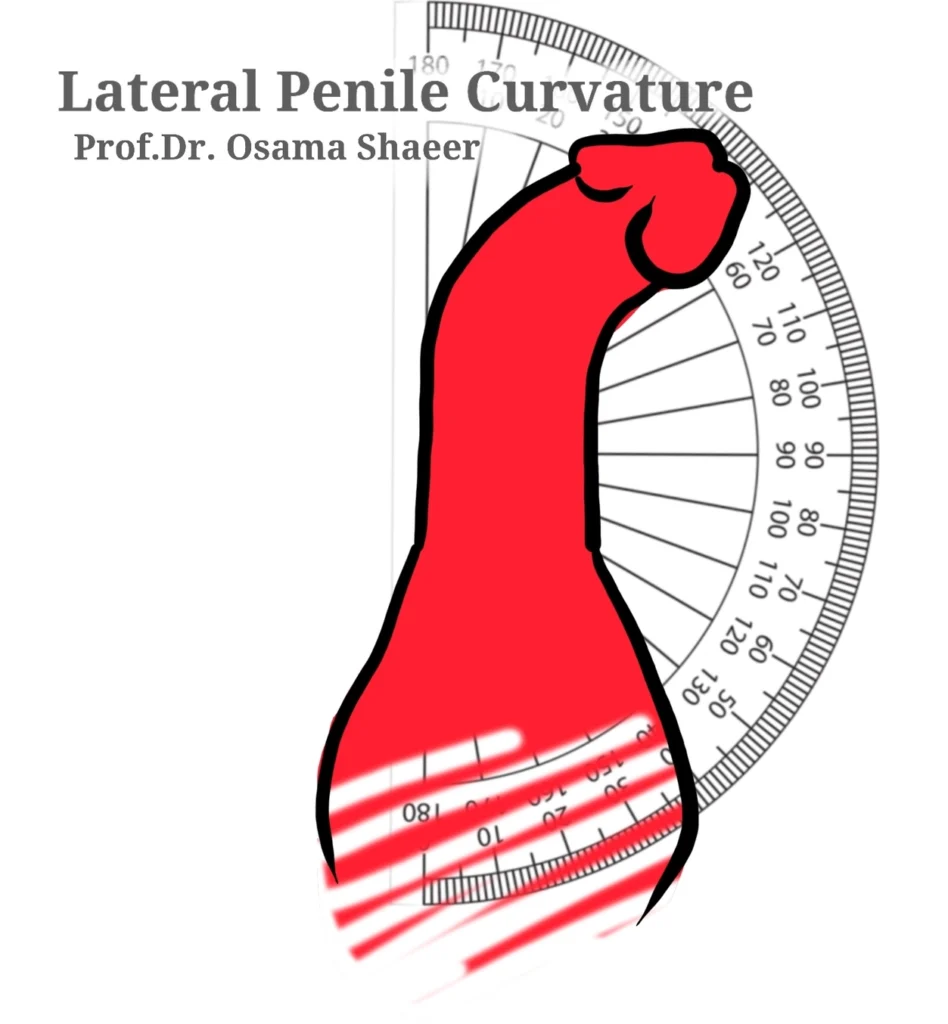
Shaeer’s corporal rotation is not for lateral penile curvature.
1.d. Multi-Axial Curvature
This is where there is a combination of the above. For example: ventro-lateral penile curvature where the penis is bent downwards and to a side, or dorso-lateral penile curvature where the penis is bent upwards and to a side.
2. Evaluation of the degree of penile curvature
- Evaluate in the erect state
- Use a protractor if needed, on a photo
- Penile curvature less than 20 degrees may not affect sexual function
This is performed in the erect state, either from a photo provided by the patient, or in-clinic where erection is induced by injection of PGE-1. Evaluation of the degree or grade of penile curvature is performed with a goniometer or a protractor, whether physical or digital. Whether penile curvature is mild, moderate or severe, this depends not only on the angle but also on the direction.
This is where there is a combination of the above. For example: ventro-lateral penile curvature where the penis is bent downwards and to a side, or dorso-lateral penile curvature where the penis is bent upwards and to a side.
2.a. Ventral penile curvature:
Ventral penile curvature less than 30 degrees is considered mild. 30 – 45 degrees is considered moderate, while downward penile curvature more than 50 degrees is considered severe.
2.b. Dorsal penile curvature:
Dorsal penile curvature less than 40 degrees is considered mild. 40 – 50 degrees is considered moderate, while upward penile curvature more than 50 degrees is considered severe.
2.c. Lateral penile curvature:
Lateral penile curvature less than 15 degrees is considered mild. 15 – 30 degrees is considered moderate, while penile curvature to the side more than 30 degrees is considered severe.
3. Evaluation of penile length
- Measure in the erect state
- Measure from the base of the penis hitting the pelvic bone to the tip of the glans
Why is length of the penis an important factor in cases of penile deviation? That is because correction of congenital curvature of the penis is classically performed by shortening the longer side: plication for penile curvature, nesbit technique, or the 16 dot technique. Alternatively, there is the length preserving technique, Shaeer Corporal Rotation. Choice between the two for correction of chordee depends on the interplay between the degree of penile deviation and length of the penis.
When performing the shortening technique for penile curvature, the higher the degree of curvature, the shorter the penis will become. If the penis is already short, it shall become even shorter. That will be a problem. There is no way to predict the degree of shortening that will occur relative to the degree of curvature when using the shortening techniques. Men with congenital curvature of the penis usually have a longer penis. However, that is not a universal rule.
Therefore, it is important to assess the length of the erect penis with flexible tape, from the tip to the base. The base of the penis is where it meets the pelvic bone; the symphysis pubis. This can be performed in the clinic in by induction of artificial erection, or the patient can take a photo on his own. Length should be evaluated by measuring the longer and shorter opposing sides.
4. Evaluation of associated abnormalities of the penis
This article is focused on isolated congenital penile curvature. For information about other types of penile curvature you can visit the links below, for other abnormalities that need to be excluded, since they are treated in a different way:
4.a. Peyronie’s disease
Peyronie’s Disease is when a male is born with a straight penis, but becomes curved later on at some point. This is due to formation of firm lumps that pull the penis to one side when erect. Those lumps are called Peyronie’s plaques. There are several ways to treat Peyronie’s disease that are discussed in the dedicated Peyronie’s section on my website. However, Shaeer’s Corporal Rotation was not extensively performed with cases of Peyronie’s curvature, and is generally reserved for congenital ventral penile curvature.
Peyronie’s disease can be detected in medical history as an acquired penile curvature, and in clinical examination as a firm lump; Peyronie’s plaque. Then, a penile ultrasound or MRI helps identification and measurement of the plaque.
4.b. Erectile dysfunction
Men with a bent penis can also have weak erection, though unrelated. This will influence decision making for treatment. Erectile dysfunction (ED) is evaluated on history taking. A dedicated questionnaire is particularly useful in diagnosing ED; the International Index of Erectile Function (IIEF). IIEF can be administered online or at the clinic. Further evaluation for the cause of ED is conducted by measuring sex hormones (testosterone, prolactin, estradiol), serum lipids, blood sugar profile, and penile duplex.
ED is mostly treated medically: medical treatment of erectile dysfunction. In case of failure of rejection of medical treatment for ED, penile implant surgery can be performed. Penile prosthesis implantation (PPI) is the definitive treatment for ED. Congenital curvature of the penis can be treated at the same session along with PPI
4.c. Hypospadias and Epispadias
In those conditions, the urethral meatus is abnormally situated along the shaft of the penis rather than at the tip, along with chordee – penile curvature. Those are managed differently from isolated congenital penile curvature, mostly by urethroplasty alongside shortening techniques or chordee excision.
Frequently Asked Questions
How do I measure penile curvature at home?
The degree of curvature can be estimated by comparing the erect penis to a straight reference line or using an angle guide. Our interactive self-test allows patients to estimate the degree of curvature visually.
– Take the penile curvature online self test
– Send a photo in the erect state to a penile curvature expert
– Have an online consultation with an expert in penile curvature
– Visit an expert on penile curvature surgery
How do I tell if my curved penis requires surgical correction
For that, you need an expert opinion, possibly via online consultation. However, broadly speaking, a downward curve of more than 30 degrees, a laterally curved penis of more than 20 degrees or a dorsal penis curve of more than 40 degrees are recommended for surgical correction.
What degree of penile curvature is considered severe?
Severity depends on the direction of curvature:
Ventral curvature >50°
Dorsal curvature >50°
Lateral curvature >40°
Multi-axial curvature >40°
These degrees may interfere with sexual function and often require surgical correction.
What causes penile curvature ?
Congenital penile curvature is inborn. You’ve had it for as far as you can recall. You cannot recall a time when the erect penis was straight. It does not progress. There is no firm nodule in the penis. Acquired penile curvature develops spontaneously, due to trauma, or penis injections. It is one that developed after the penis was most definitely straight. There may be a nodule and or pain. It progresses with time for a year or so.
Does penile curvature in the flaccid state count ?
No. Penile curvature is clinically relevant only in the erect state.
What is the difference between Peyronie’s disease and congenital penile curvature?
Congenital curvature is present since the beginning of erections and is usually stable.
Peyronie’s disease develops later in life due to fibrous plaques in the penis.
Medical Author
Prof. Dr. Osama Shaeer
- Professor of Andrology, Cairo University
- Academician at the European Academy of Andrology
- Seventh President, Middle East Society for Sexual Medicine (MESSM)
- Multiple Awards in Surgical Andrology
- 60+ International Publications
Specialties
- Penile curvature surgery
- Peyronie’s disease
- Penile prosthesis surgery