Prof.Shaeer; the Peyronie’s Disease Expert
Here is everything you need to know about Peyronie’s Disease Surgery
Treatment of Acquired Penile Curvature – Peyronie’s Disease Deformity
Treatment of penile curvature is essentially surgical , if the degree of penile deviation warrants intervention. This is true for all cases of congenital penile curvature . However, some early cases of acquired penile curvature / Peyronie’s disease may respond to medical treatment.
Table of Contents
What is Peyronie’s Disease ?
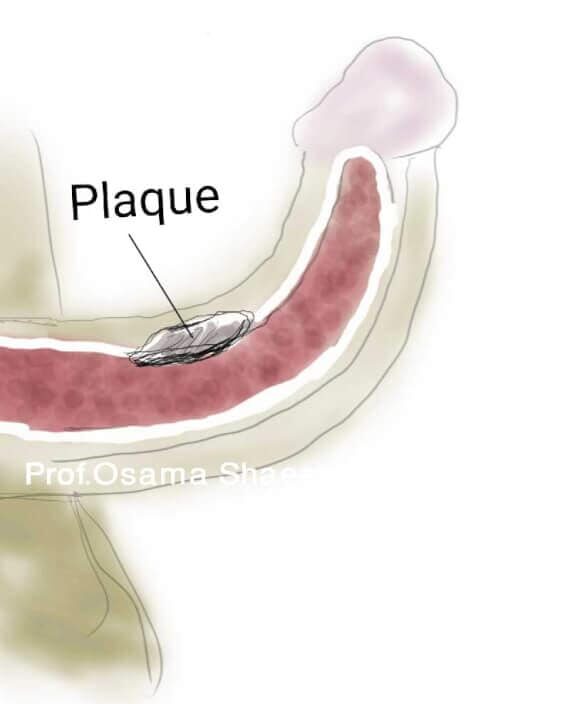
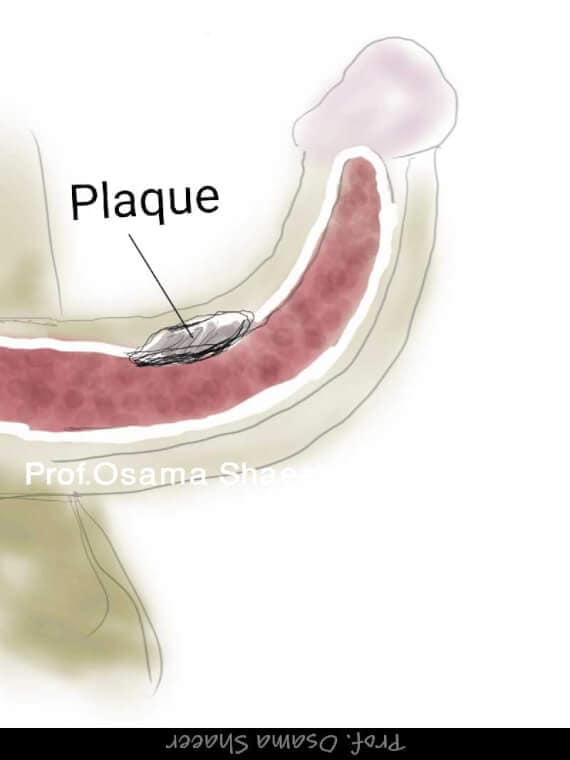
Acquired penile curvature or Peyronie’s deformity is when penile curvature is not since birth , but develops later in life ,commonly above the age of 40. This can be spontaneous, or following trauma to the erect penis . So, the erect penis became bent at some point , after years of being straight. Peyronie’s disease is a process of fibrosis of the penis. Fibrosis is when elastic tissue becomes hardened . Those hard bits are known as Peyronie’s plaques
Causes of Peyronie’s Disease
- Spontaneous
- Trauma
- Intracavernous injections for erectile dysfunction
Read More..
One theory for the cause of Peyronie’s disease is trauma . When the erect penis is repeatedly bent or twisted such as during intercourse, the internal tissues break, and heal by fibrosis. Other less common causes of acquired penile curvature fracture penis and intracavernous injections ( ICI ). Fracture penis is when the there is direct severe trauma to the erect penis such as during sex, and there is immediate pain, and possibly a popping sound, followed by loss if erection and possibly a swelling. If fracture penis is not surgically repaired early enough, penile fracture will heal by fibrosis and possibly end up with acquired penile deviation. On the other hand, intracavernous injections ( ICI ) are shots injected to the penis to induce erection in severe cases of impotence. A man injects a shot every time he required erection. Repeated use of intra-cavernous injections ( ICI ) may lead to fibrosis and acquired penile curvature . Rare causes of penile deviation include penile augmentation surgeries that go wrong, especially penile girth augmentation / penile widening surgeries with fat or silicon injection. Juelqing technique / exercises can also cause deviation of the penis.
Peyronie’s Disease Symptoms
- Pain
- Firm lump
- Penis Curvature
- Penis narrowing
A man starts feeling Peyronie’s plaques in the shaft of the penis, and when erection occurs, the penis is curved in the same direction of the Peyronie’s plaques . This can be associated with pain in the first one to two years after Peyronie’s disease starts. Peyronie is commonly associated with erectile dysfunction ( weak erection ) and is more common in diabetics.
Peyronie’s Disease Timeline
- Early phase: 1-2 years, painful, progressive
- Maturation phase: no pain, no further progress
Peyronie’s disease progresses through the first two years , with progressive loss of length of the erect penis and penile curvature . There may also be loss in penile width ( penile girth ) in a part of the penis leading to a sort of waist formation ( Peyronie’s hour-glass deformity ). After one to two years, Peyronie’s disease usually stabilizes with no further damage.
What degree of penile curvature requires correction ?
Upward penile curvature or dorsal penile curvature is the most forgiving of all, since the normal direction of the vagina is slightly upwards . Therefore , upward penile deviation is acceptable up to 45 degrees from a functionality view point. On the other hand, downward penile curvature or ventral penile curvature is acceptable up to 30 degrees. Penile curvature to the left or penile curvature to the right ( lateral penile curvature ) is acceptable up to 20 degrees. Otherwise, a bent penis may require correction. Check our guide for evaluation of penile curvature.
Read More…
As regards a penis that is bent downwards, ventral penile deviation less than 30 degrees is considered mild penile curvature. More than 30 degrees is considered moderate penile curvature . More than 50 degree of ventral penile deviation is considered a severe bend in the penis. Lateral penile curvature more than 20 degrees is considered moderate lateral penile deviation . More than 40 degrees of lateral penile deviation is considered severe curve in the penis . Finally, upward curve of the penis is considered moderate dorsal penile curvature if between 40 and 60 degrees. More than 60 degrees of dorsal curve of the penis is considered severe.
Whatever the degree of penile deviation is, any case with progressively increasing penile curvature or with a lump in the penis ( Peyronie’s disease ) requires medical consultation. A curved penis of any degree that causes discomfort or pain to one or both partners warrants consultation. Also, any grade of penile curvature that is unappealing from a cosmetic view point can be corrected.
How to diagnose penile curvature ? How to check the degree of penile deviation and decide the cause of bend in the penis ?
- Examination of a photo in the erect state
- Clinical examination with artificial erection
- Evaluation of erectile function
- Penile Duplex
The degree of penile curvature is determined in the fully erect state. Erection can be induced spontaneously by arousal / manual stimulation , or can be induced by a clinical erection test, where an erection-inducing medicine is injected in the penis with a very tiny needle, barely painful ( intracavernous injection / ICI ). Experts in penile curvature such as Prof.Osama Shaeer are the ones who can accurately determine the grade of penile deviation. Prof.Osama Shaeer provides an online video consultation service to give a provisional opinion. A photo or several photos of the erect penis are needed for an opinion on the grade of the curve in the penis.
We also inquire on the effect of this bend in the penis on sexual intercourse, if the patient has had any past sexual experiences. Some patients don’t have sexual encounters if the degree of penile deviation is too high. They either find it difficult or impossible to make love. Some are embarrassed from the shape of the bent penis and avoid sexual contact. However, if the curved penis did not hinder sexual intercourse, then it can be deemed fine to live with it. Otherwise, surgical correction of a bent penis is easy for experts.
We also check for four important criteria in the diagnosis of penile curvature: the position of the urethral meatus, whether or not there are lumps in the penis ( Peyronie’s plaques ) that indicate the presence of Peyronie’s disease, shortening or narrowing of the penis, and erectile function. Evaluation of erectile function is important in the evaluation of penile deviation since many cases of acquired penile deviation / Peyronie’s disease are associated with erectile dysfunction ( ED / weak erection ).
An ultrasound of the penis / penile doppler can accurately determine the presence of Peyronie’s plaques , site and size of Peyronie’s lumps and the progress of Peyronie’s disease . If associated with an erection test , penile duplex will also determine erectile function and the local cause of ED -if any.
Those are the core criteria in the diagnosis and evaluation of penile curvature . There are more fine details in the workup of a case of penile deviation , especially of surgical correction of the curved penis is warranted.
Treatment of penile curvature / Correction of a curved penis / Treatment of Peyronie’s Disease
Medical Treatment of Peyronie’s Disease
- May help in the early phase of Peyronie’s disease
- Limited effect
- Oral treatment or intra-lesional injections
This includes oral treatment or intralesional injection of Peyronie’s plaques. Oral treatment includes tamoxifen, vitamin E, colchicine, Potaba, among others. They are essentially for damage control. They do not usually correct the Peyronie’s Disease deformity. On the other hand, intralesional injection therapy for Peyronie’s Disease has had some degree of success, especially with collagenase injections, and to a lesser extent with steroids or verapamil. Generally speaking, medical treatment for Peyronie’s Disease has limited success and is reserved for the early cases of active Peyronie’s Disease, in the first year or so 1.
Surgical Treatment of Peyronie’s Disease Curvature
- Shortening Techniques
- Peyronie’s plaque excision and grafting
- Penile prosthesis implantation with Peyronie’s adjuvant techniques
Surgery is the mainstay for correction of Peyronie’s deformity. It is mostly a one day surgery, with no overnight hospital stay required. Mobility of same day following surgery. Pain is mild to moderate , nothing severe .
1. Shortening techniques for Peyronie’s Disease penile curvature – Plication surgery for Peyronie’s deformity
If the penis is curved downwards , correction of this downward curve of the penis can be by stitches that shorten the upper side, pulling the penis upwards. If the penis is bent upwards, it can be straightened by plication sutures ( stitches ) that shorten under-surface. If the penis is curved to the left , plication of the right side pulls the penis in the correct straight direction. This corrects Peyronie’s curvature on the expense of length.
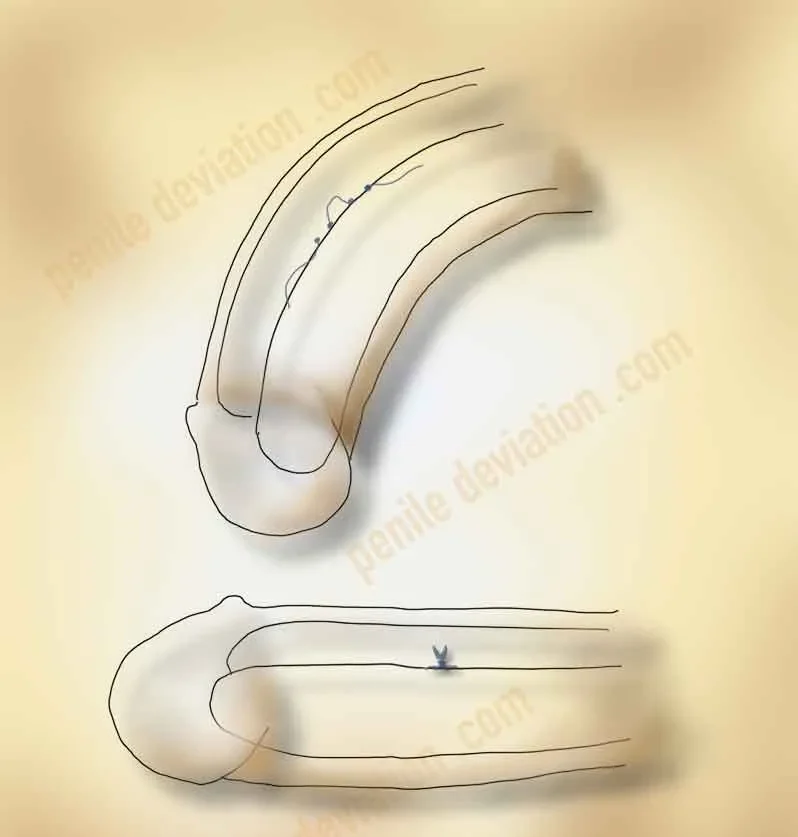
It is most suited for mild or moderate degrees of penile curvature since the loss in length by shortening techniques will not be considerable. Shortening techniques are the simplest of all types of surgery for Peyronie’s curvature, therefore the most widely used , particularly by emerging surgeons .
Learn more:
2. Elongation techniques for penile curvature | Plaque surgery for Peyronie’s disease 2
- Advantages of Peyronie’s Plaque Surgery
- Restoration of straightness and length
- Disadvantages Peyronie’s Plaque Surgery
- Possible decrease in sensitivity: countered by expert techniques in
- Possible recurrence: due to graft contracture.
- Possible erectile dysfunction: treated by erection enhancing medications or penile prosthesis implantation.
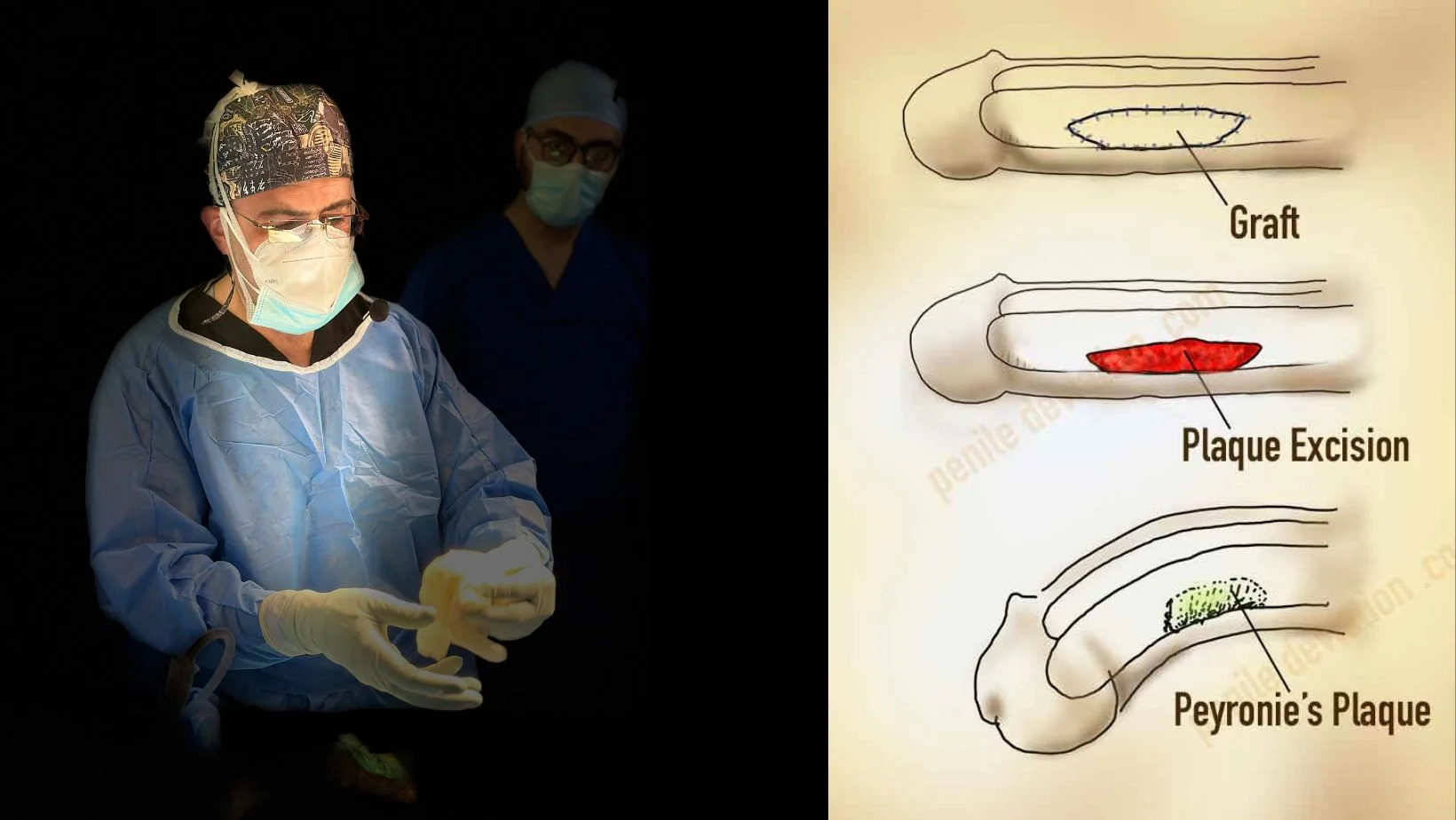
Peyronie’s plaque surgery aims at correcting the penile curvature and shortening that resulted from Peyronie’s disease. This involves either by removing the plaques altogether and closing the gap with a graft ( Peyronie’s Excision and Grafting ), or by slitting them open to relax the contracture, with grafting if needed ( Peyronie’s Incision and Grafting ). This is most feasible when the Peyronie’s plaques are not too extensive and the curvature is not severe. Good erection is important in patient selection.
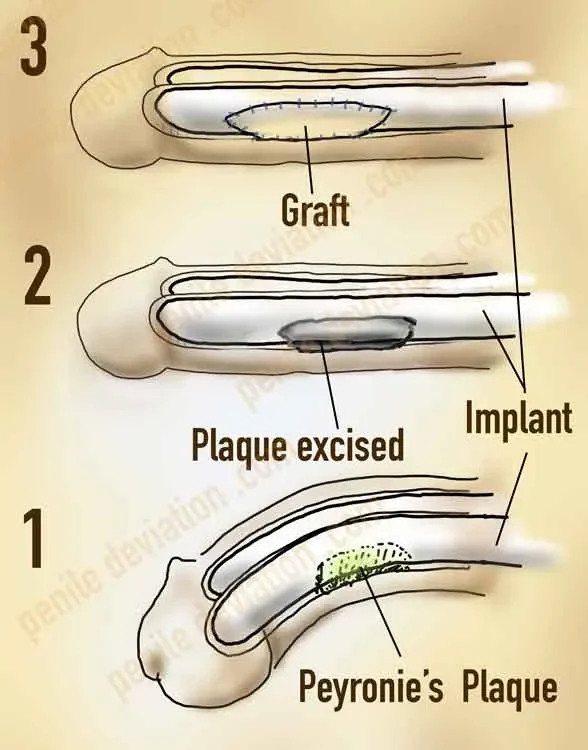
On the downside for Peyronie’s Plaque Excision and Grafting, there may be some decrease in sensitivity of the penis. The sensory nerves that give sensitivity and pleasure sensation to the penis, they run along the tunica albuginea ( walls of the erection cylinders ), those walls that have been afflicted by Peyronie’s. The nerves run along the upper surface of the tunica albuginea. Also, the urethra courses along the lower surface of the tunica. In order to access the plaques, the surgeon needs to mobilize the nerves or the urethra, which may affect sensitivity of the penis or may cause urethral injury. Finally, removing parts of the erection cylinders as fore mentioned may result in erectile dysfunction in some cases. Those complications are not very common, but remain a possibility, and have to be weighed against the benefits.
The graft is usually and allograft, meaning that it is a graft extracted from the human body. Examples are dermal grafts which are taken from under the skin. Such grafts carry a low probability of rejection. However, they may contract with time, leading to possible recurrence of curvature. Other grafts are ready made ones taken from animals such as bovine or porcine grafts.
Who is Peyronie’s Plaque Excision and Grafting Surgery for ?
Cause of penile curvature: Peyronie’s disease
Direction: Any direction
Degree: For mild to moderate degrees, Peyronie’s Plaque Surgery can be performed without a penile implant. However, if curvature is severe due to extensive Peyronie’s plaques, erectile dysfunction may follow. Peyronie’s Plaque Surgery is then combined with penile implant surgery . For mild degrees of penile curvature, shortening techniques can be the more simple and easy alternative, particularly that shortening techniques for penile curvature do not affect erection. If the curvature is mild, then the shortening will be mild as well.
Length of penis: Any length.
Erection: Good erection is a prerequisite. Otherwise, it is recommended to combine peyronie’s plaque surgery with a penile implant.
Timing: Peyronie’s disease develops over the course of one to two years where the curvature and shortening become worse. After this phase is over, there is no further worsening in curvature and shortening. This is when surgical intervention is warranted. Peyronie’s disease starts way before the patient notices it, advances with time until it becomes noticeable. So, the time count starts around 6 months before the patient notices the curvature or mass.
Steps of Peyronie’s Plaque Surgery | Peyronie’s Excision and Grafting
Total Time: 1 hour and 30 minutes
1-Induce Artificial Erection and evaluate penile curvature
The penis is injected with a vasoactive material to induce full erection such as Prostaglandin E1. Re-evaluate the degree and direction of curvature. Determine the point of maximum penile curvature.
2- Skin incision for plaque surgery
In most cases, the skin incision for correction of Peyronie’s curvature is a subcoronal incision, circumferentially under the glans penis .
3- Exposure
The skin and subcutaneous layers are dissected to reveal the erection cylinders (corporal cavernosa). If the incision is subcoronal, this is performed by degloving, where the skin is pulled down to the base of the penis.
4-Mobilization of the neurovascular bundle
The neurovascular bundle is composed of nerves and blood vessels that course on the surface of the corpora cavernosa. The bundle is set aside at the point of maximum penile curvature to expose the site of Peyronie’s plaques .
5- Peyronie’s plaque excision or Peyronie’s plaque incision
The Peyronie’s plaque is in the covering of the corpora cavernosa. This covering is called the tunica albuginea. The plaque is removed by scalpel, preserving the erectile tissue inside the corpora cavernosa ( Peyronie’s plaque excision ). This restores straightness and length to the curved penis. Alternatively in milder degrees of curvature, the plaque can be incised by scalpel. Plaque incision relieves the contracture that is causing penile curvature and may restore length and straightness.
6- Grafting
Peyronie’s plaques incision or excision creates a gap that needs to be closed. This is performed by suturing a graft to cover the defect.
7- Repositioning the neurovascular bundle
The neurovascular bundle is returned in place.
8 – Re-testing penile deviation
Artificial erection is induced again to check that the curved penis has become fully straight.
9-Skin closure
Skin and subcutaneous layers are sutured closed
Estimated Cost: 5000 USD
3. Penile Implant Surgery in Peyronie’s Disease
Many cases of penile curvature are associated with weak erection (erectile dysfunction), particularly Peyronie’s disease cases . If erectile dysfunction does not respond to erection enhancing medication, then a penile prosthesis can be implanted (penile implant) along with correcting the curvature by any of the aforementioned techniques for correction of penile curvature 3. A penile prosthesis is synthetic implant that is hidden inside the penis , and can give excellent erection , anytime , for any length of time , possibly lifelong
Frequently Asked Questions
What is the treatment of Peyronie’s Disease ?
Shortening techniques are the most conservative and simple techniques, suited for most cases of mild to moderate penile curvature. 16-Dot technique and the double-8 techniques are the most recent advancements.
How long do I have to stay in the hospital for penile curvature correction surgery ?
Prof.Shaeer has rendered penile curvature surgery to be a one day surgery. Patients leave the hospital same day, and can travel by air the next day of needed.
Which cases of penile curvature are eligible for Shortening techniques ?
Shortening techniques for correction of penile curvature such as Nesbit, plication, 16-dot technique and double-8 technique are suited for penile curvature of any cause or direction, provided erection is good, the degree of curvature is not severe (otherwise the final length of the penis will not be satisfactory) and that the penis is not too short. Plication for penile curvature and other shortening techniques are suited for penis curved down, penis curved up, penis curved to the left or penis curved to the right.
Who is eligible for Peyronie’s Excision and Grafting?
A case of Peyronie’s disease with good erectile function and moderate curvature, in the stable phase of Peyronie’s disease, who will not accept a shorter penis with the less invasive shortening techniques
Can Peyronie’s Disease heal itself ?
Rare cases may improve spontaneously. However, most cases will progress, then stabilize after one to two years.
How long does it take to recover from Peyronie’s surgery?
You may leave the hospital the same day in most cases. Limited activity is allowed for the first two weeks, such as office work. Exercise permissible after 2-3 weeks. Intercourse permissible after 1.5-3 months. The later the better.
Is Peyronie’s surgery painful?
You may expect mild to moderate pain. Nothing severe in the vast majority.
References
- Li EV, Esterquest R, Pham MN, Panken EJ, Amarasekera C, Siebert A, Bajic P, Levine LA. Peyronie’s disease: pharmacological treatments and limitations. Expert Rev Clin Pharmacol. 2021 Jun;14(6):703-713. doi: 10.1080/17512433.2021.1903873. Epub 2021 Mar 25. PMID: 33719851.
↩︎ - Langbo WA, Wang V, Bajic P, Levine L. Long-term outcomes after plaque excision grafting for Peyronie’s disease and subanalysis of patients who undergo the procedure despite preoperative counseling against it. J Sex Med. 2024 Jan 30;21(2):163-168. doi: 10.1093/jsxmed/qdad164. PMID: 38087916. ↩︎
- Good J, Crist N, Henderson B, Karcher C, Sencaj J, Bernie HL. Inflatable penile prosthesis placement in Peyronie’s disease: a review of surgical considerations, approaches, and maneuvers. Transl Androl Urol. 2024 Jan 31;13(1):139-155. doi: 10.21037/tau-23-180. Epub 2024 Jan 23. PMID: 38404553; PMCID: PMC10891387. ↩︎
Medical Author
Prof. Dr. Osama Shaeer
- Professor of Andrology, Cairo University
- Academician at the European Academy of Andrology
- Seventh President, Middle East Society for Sexual Medicine (MESSM)
- Multiple Awards in Surgical Andrology
- 60+ International Publications
Specialties
- Penile curvature surgery
- Peyronie’s disease
- Penile prosthesis surgery