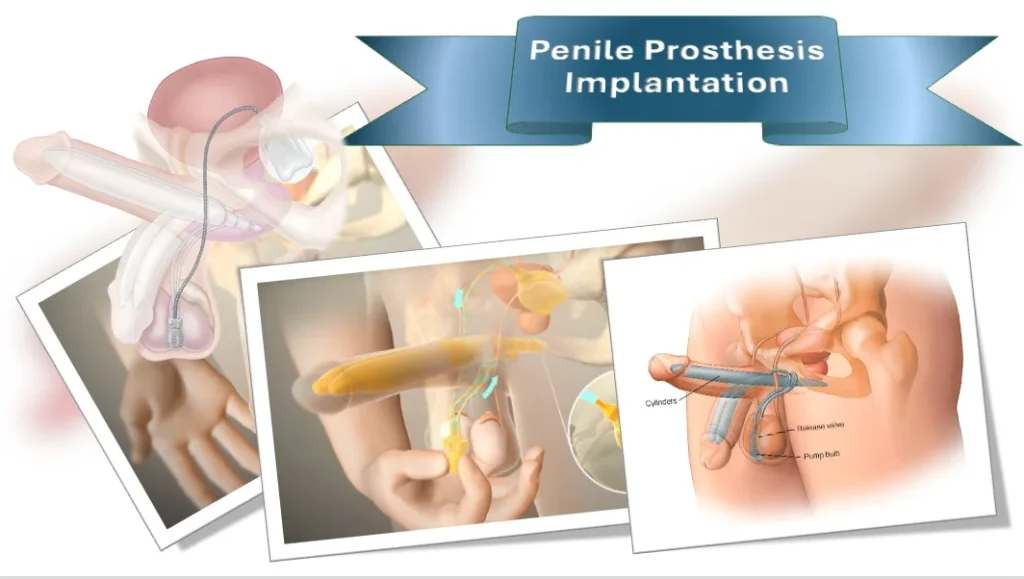
Penile Prosthesis Implantation
Excellent Penis Rigidity, Anytime, All the time!
Penile Implant Surgery for Peyronie’s Disease
A penile prosthesis / penile implant is a medical device that is implanted into and hides inside the penis, giving it excellent erection, any time, for any length of time. Peyronie’s disease is commonly associated with erectile dysfunction / weak erection . This can be an indication for penile implant surgery . Penile prosthesis surgery in cases of Peyronie’s disease must be aided with adjuvant measures to correct the curvature and deformity, such as modeling of the penis or plaque surgery.
Penile implants are cylindrical devices in the shape of the erection cylinders. One cylinder is inserted into each erection cylinder ( corpus cavernosum ), in a brief surgery. Patients can usually leave the hospital the same day unassisted.
Prof.Osama Shaeer is one of the world-leading surgeons, mentors and innovators in the field of penile prosthesis implantation.
Following penile prosthesis surgery in cases of erectile dysfunction or Peyronie’s deformity, a patient with a penile implant looks totally normal, feels totally normal, has desire, has ejaculation, has pleasure sensation, and can perform without limits. This is unless there is another disorder that may affect the fore mentioned.
Table of Contents
Types of Penile Implants
Penile implants come in two main categories: malleable penile implants (semi-rigid penile implants) or inflatable penile implants (hydraulic penile implants). Both are valid for Peyronie’s cases, though an inflatable is preferred.
Malleable Penile Implants
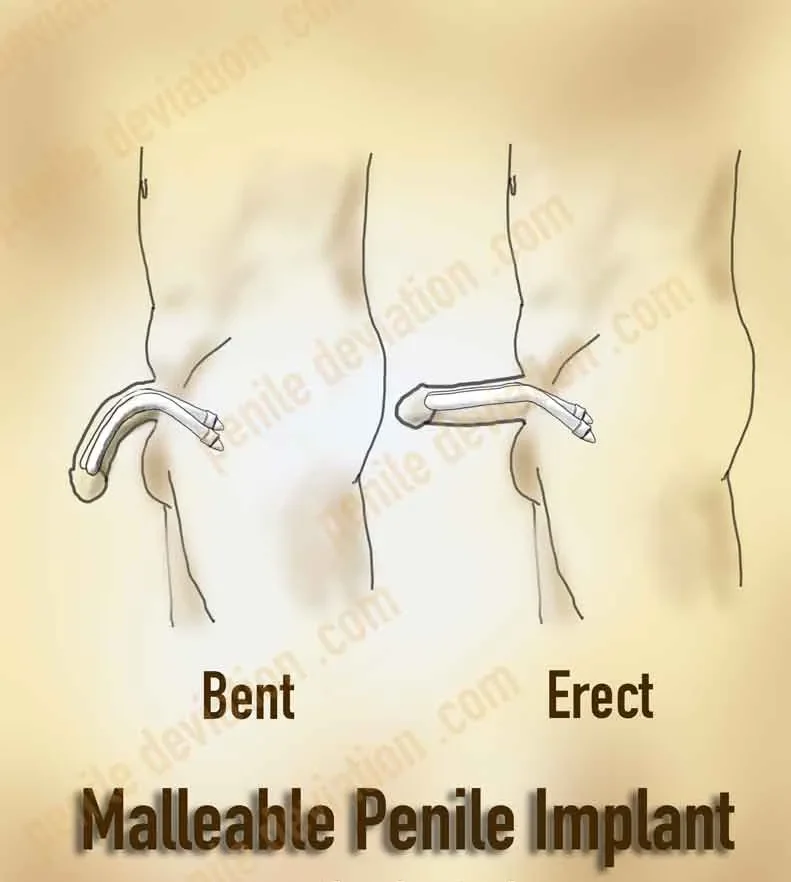
The malleable implant has a metal rod in its core, surrounded by medical grade silicone. Being malleable, they can be bent or straightened. Accordingly, the penis can either be erect, or bent down for concealment.
- Pros
- Cost effective
- Very low risk of mechanical failure
- Cons
- Less concealable, more so in Peyronie’s disease
- Does not expand, and will therefore give slightly less size compared to inflatable
Watch the Malleable Penile Prosthesis in Real Life
Inflatable Penile Implants
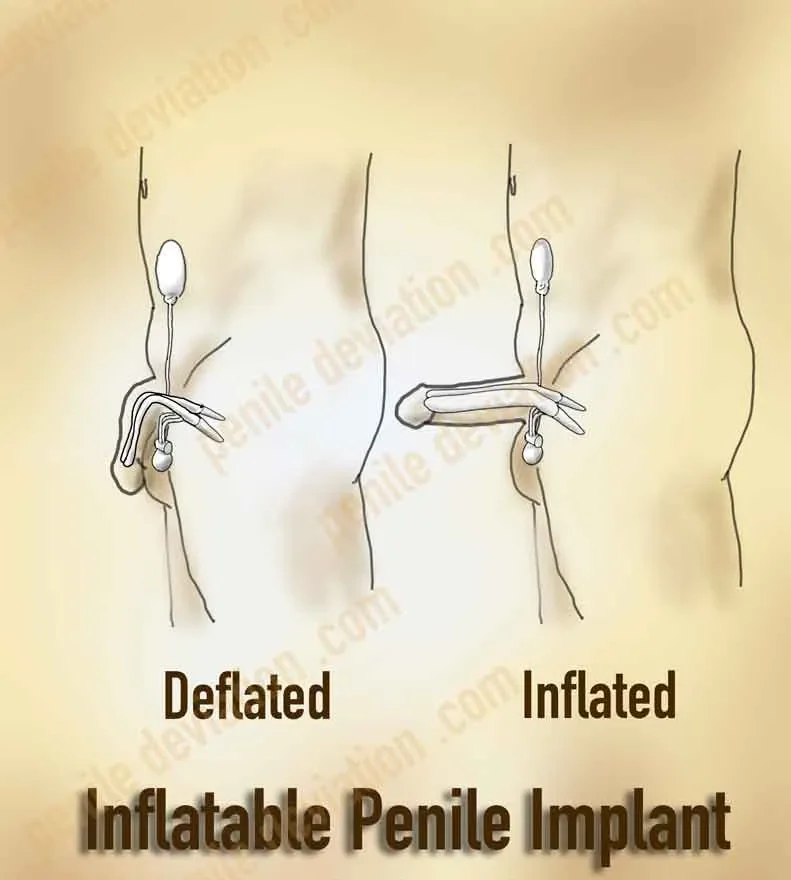
An inflatable penile implant makes the penis erect or flaccid, controlled by a small pump inside the scrotum (nothing visible). The pump inflates or deflates the inflatable implant cylinders.
- Pros
- Totally concealable
- Expands, therefore offers better size
- Preferred in Peyronie’s disease cases
- Cons
- More costly
- Possible need for replacement due to possible mechanical failure
Watch the Inflatable Penile Prosthesis in Real Life
In a case of severe Peyronie’s disease , or Peyronie’s disease associated with weak erection, penile prosthesis surgery will give excellent erection. However, the penile implant will not on its own correct Peyronie’s deformity, Peyronie’s curvature , shortening or narrowing. Those require adjuvant measures that are performed during the same surgery.
Which penile implant is best for me?
For cases with Peyronie’s disease, both the malleable and the inflatable penile implant will do fine, with the adjuvant measures to correct Peyronie’s deformity. However, the inflatable penile implant is generally preferable for Peyronie’s cases as it confers better size, helping restore the size lost to Peyronie’s to some extent. It also deflates rather than bends, conferring better concealment. However, the expert will help you choose the penile implant that suits you the most
Adjuvant Measures for Peyronie’s Disease Along with Penile Prosthesis Implantation
Modeling Technique
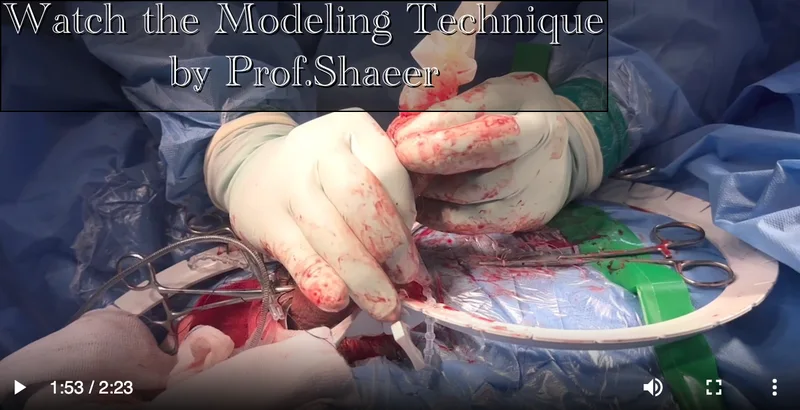
Modeling technique 1 is the simplest correction technique for Peyronie’s disease deformity, suited for milder cases. Simply, after the penile implant is in, the penis is forcibly bent in the direction opposite to that of the penile curvature. Bending is maintained for 60 seconds until the Peyronie’s plaque breaks. Modeling Peyronie’s plaques corrects mild degrees of Peyronie’s curvature.
Peyronie’s Plaque excision / Peyronie’s Plaque Incision 2
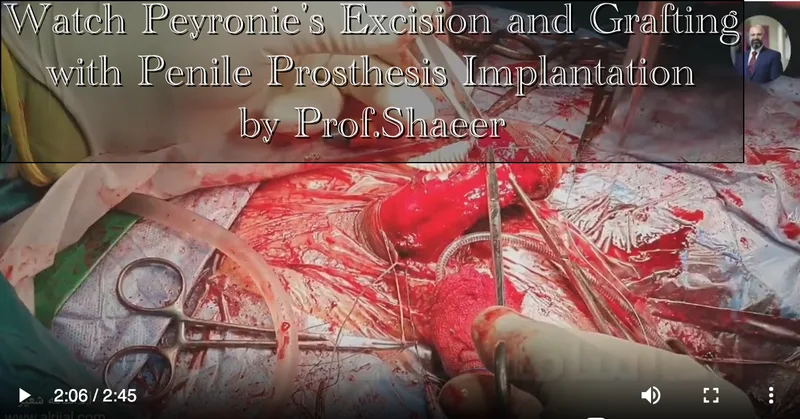
If modeling does not correct curvature, the Peyronie’s plaque causing the curvature can be removed or slit. A graft can be placed to close the defect. Penile implant surgery is performed in the same setting to give excellent rigidity.
Peyronie’s plaques are formed in the walls of the erection cylinders (Tunica Albuginea). Sensory nerves and blood vessels ( neurovascular bundle ) course on the outer surface of the tunica albuginea and have to be set aside to reach the Peyronie’s plaque and remove it. This may affect sensitivity of the penis in some cases. Therefore, neurovascular bundle mobilization is performed, to set the nerves aside, out of harm’s way. Prof.Shaeer perfected this technique:
Shaeer’s Innovations
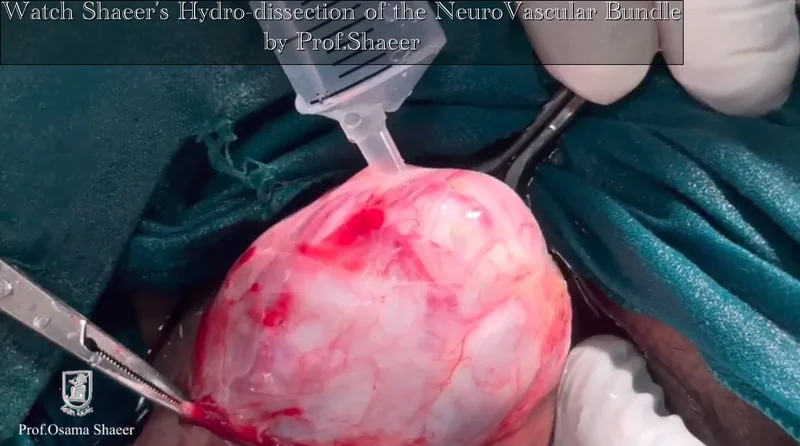
1. Shaeer’s Hydro-dissection of the NeuroVascular Bundle
Prof. Shaeer invented a technique 3 to render mobilization of the neuro-vascular bundle quicker and safer. Prof.Shaeer injects sterile saline with an analgesic into the Buck’s Fascia, which swells up accordingly. The swollen Buck’s fascia can then be undermined and mobilized with relative ease. The analgesic injected makes the recovery period much more pleasant.
2. Shaeer’s Punch Technique – Optical Corporotomy
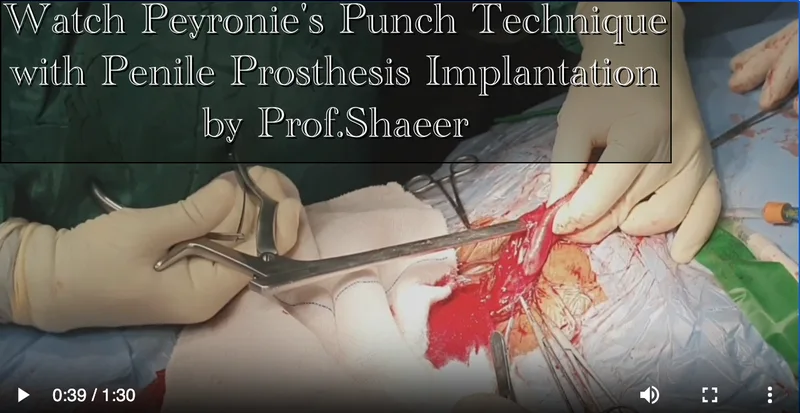
The neurovascular bundle is a collection of nerves and vessels that course on the outer surface of the erection cylinders. Those should be protected. However, in order to reach the Peyronie’s plaque from outside, the bundle has to be set aside (mobilization of the neurovascular bundle). This may still affect penile sensitivity. How about removing Peyronie’s plaques from inside the erection cylinders where there are no sensory nerves?
Prof.Shaeer invented two techniques whereby Peyronie’s plaques are removed from inside the erection cylinders rather than from outside, thereby avoiding the sensory nerves altogether, Not only does this protect sensitivity of the penis and pleasure sensation, but it also shortens operative time significantly. The two techniques are: Punch Technique 4 and Optical Corporotomy
Shortening techniques along with penile prosthesis implantation
Shortening techniques correct penile curvature by shortening the longer side of the penis to match the shorter one. For example, if there is a Peyronie’s plaque on the right side causing penile curvature to the right, the left side of the penis can be shortened by plication sutures so that both sides match in length, thereby straightening the penis. A penile implant can be implanted in the same session. The plication sutures can be preplaced , then the penile prosthesis implanted , then the plication sutures are tied and tightened to the extent needed to correct the penile curvature . Naturally, this is only performed in milder degrees of penile deviation and only if the penis is not too short, since the plication technique for penile curvature causes loss in the length of the penis. They can be coupled with penile enhancement surgery to restore some length to the penis.
Learn more:
Advantages of Penile Implant surgery with Peyronie’s Plaque Surgery
- Restoration of straightness and possibly length
- Restoration of rigidity and full erection
Disadvantages Penile Implant surgery with Peyronie’s Plaque Surgery
- When a penile implant is inserted, there is a 1% possibility that contamination of the penile prosthesis may occur, despite taking the maximum precautions. If this occurs, the penile implant has to be removed, and another penile prosthesis is implanted after a couple of weeks.
- Peyronie’s plaque excision and grafting or Peyronie’s plaque incision and grafting may require mobilization of the nerves and vessels that course on the erection cylinders (mobilization of the neurovascular bundle) which may cause some decrease in sensitivity. This can be avoided by using Shaeer’s Punch Technique or Shaeer’s Optical Corporotomy
Who is Penile Implant surgery with Peyronie’s Plaque Surgery for ?
- Cause of penile curvature: Peyronie’s disease
- Direction: Any direction
- Degree: For moderate to severe degrees of curvature, or mild curvature associated with erectile dysfunction.
- Length of penis: Any length.
- Erection: Penile implant surgery is reserved for cases of erectile dysfunction / weak erection who do not respond to medical treatment.
- Timing: It is preferable to wait until Peyronie’s deformity stops worsening. Peyronie’s disease develops over one to two years from when it first started. This is not when the patient noticed the Peyronie’s deformity, but is around six months before that point in time.
Frequently Asked Questions
How is weak erection with Peyronie’s disease treated ?
In case there is weak erection together with Peyronie’s deformity, the choice of treatment depends on the severity, timing, response to treatment and patient choice. If erectile dysfunction is mild, medical treatment is tried first. If there is a good response then erectile dysfunction does not require penile implant surgery, and surgery is performed to correct Peyronie’s deformity. If Peyronie’s deformity is mild, then it can be left as is. If it is moderate, then surgery can be performed to correct penile curvature, mostly the shortening techniques for penile deviation or Peyronie’s plaque incision and grafting (though the latter may weaken erection). If the Peyronie’s deformity is severe, then it is advisable to perform penile prosthesis implantation along with plaque surgery or other adjuvant techniques. Finally, since Peyronie’s disease increases over the course of one to two years, it is preferable to postpone intervention until stabilization of Peyronie’s deformity.
What is penile implant surgery?
A penile implant is a medical device that is implanted into and hides within the penis, giving it excellent rigidity. Penile implant surgery is performed in case of erectile dysfunction or severe Peyronie’s deformity , or if both are co-existing.
What are the types of penile implants ?
Exist two categories for penile implants: The first category is malleable penile implants or semi-rigid penile implants, which are always hard. However, they are malleable, meaning they can be bent downwards for concealment. The second category is the inflatable penile implants which are composed of soft cylinders that can fill up by squeezing a small pump hidden inside the scrotum so they become hard.
How do you implant a penile prosthesis in a case of Peyronie’s Disease ?
In case there is a severe Peyronie’s deformity , a penile implant can be inserted, along with extra maneuvers to correct Peyronie’s deformity such as modeling technique, Peyronie’s plaque incision and grafting , Peyronie’s plaque excision and grafting , Shaeer’s Punch Technique or Shaeer’s Optical Corporotomy .
What are the advantages of penile implant surgery in a case of Peyronie’s Disease ?
Peyronie’s disease is frequently associated with erectile dysfunction . In case of a severe Peyronie’s deformity, Peyronie’s plaque surgery may on its own result in erectile dysfunction. Penile prosthesis implantation is a surgery for treating weak erection resulting in excellent erection. Combining penile implant surgery with Peyronie’s plaque surgery restores erection, straightness and length to the penis.
What are the disadvantages of penile implant surgery in a case of Peyronie’s Disease ?
Penile prosthesis implantation enjoys a high success rate, up to 99% in expert hands. However, in rare cases, contamination may result in the need to remove the implant and come in for a re-do after the contamination resolves. Peyronie’s plaque surgery may sometimes result in a degree of loss of sensitivity of the penis.
Medical Author
Prof. Dr. Osama Shaeer
- Professor of Andrology, Cairo University
- Academician at the European Academy of Andrology
- Seventh President, Middle East Society for Sexual Medicine (MESSM)
- Multiple Awards in Surgical Andrology
- 60+ International Publications
Specialties
- Penile curvature surgery
- Peyronie’s disease
- Penile prosthesis surgery

References
- Krishnappa P, Manfredi C, Sinha M, Arcaniolo D, Matippa P, Moncada I. Penile Modeling in Peyronie’s Disease: A Systematic Review of the Literature. Sex Med Rev. 2022 Jul;10(3):434-450. doi: 10.1016/j.sxmr.2022.01.001. Epub 2022 Feb 10. PMID: 35153155. ↩︎
- Sokolakis I, Pyrgidis N, Ziegelmann MJ, Mykoniatis I, Köhler TS, Hatzichristodoulou G. Penile Prosthesis Implantation Combined With Grafting Techniques in Patients With Peyronie’s Disease and Erectile Dysfunction: A Systematic Review. Sex Med Rev. 2022 Jul;10(3):451-459. doi: 10.1016/j.sxmr.2021.03.007. Epub 2021 Jul 1. PMID: 34219005. ↩︎
- Shaeer O, El Debs H, Elahwany A, Shaeer KOKM Jr, Shaeer K. Shaeer’s hydro-inflation technique for neurovascular bundle mobilization during penile surgery. Int J Impot Res. 2025 Aug 21. doi: 10.1038/s41443-025-01153-z. Epub ahead of print. PMID: 40841763. ↩︎
- Shaeer O, Soliman Abdelrahman IF, Mansour M, Shaeer K. Shaeer’s Punch Technique: Transcorporeal Peyronie’s Plaque Surgery and Penile Prosthesis Implantation. J Sex Med. 2020 Jul;17(7):1395-1399. doi: 10.1016/j.jsxm.2020.03.018. Epub 2020 May 7. PMID: 32389586. ↩︎